CJC-1295 is a synthetic growth hormone-releasing hormone (GHRH) analog developed by ConjuChem with drug affinity complex (DAC) technology for extended half-life. It is not FDA-approved for any indication; ConjuChem discontinued clinical development. It is widely used in research-chemical and telehealth contexts, frequently stacked with ipamorelin.
Growth hormone-releasing hormone (GHRH) analog peptide
CJC-1295 (with DAC)
CJC-1295 with DAC is a synthetic GHRH analog developed by ConjuChem using drug affinity complex (DAC) technology to bind albumin and extend half-life to 6-8 days. It is not FDA-approved; ConjuChem discontinued clinical development. A separate profile covers CJC-1295 without DAC (Mod GRF 1-29), the short-acting form commonly stacked with ipamorelin.
Evidence review
Last reviewed Aug 5, 2026
Next review Sep 5, 2026
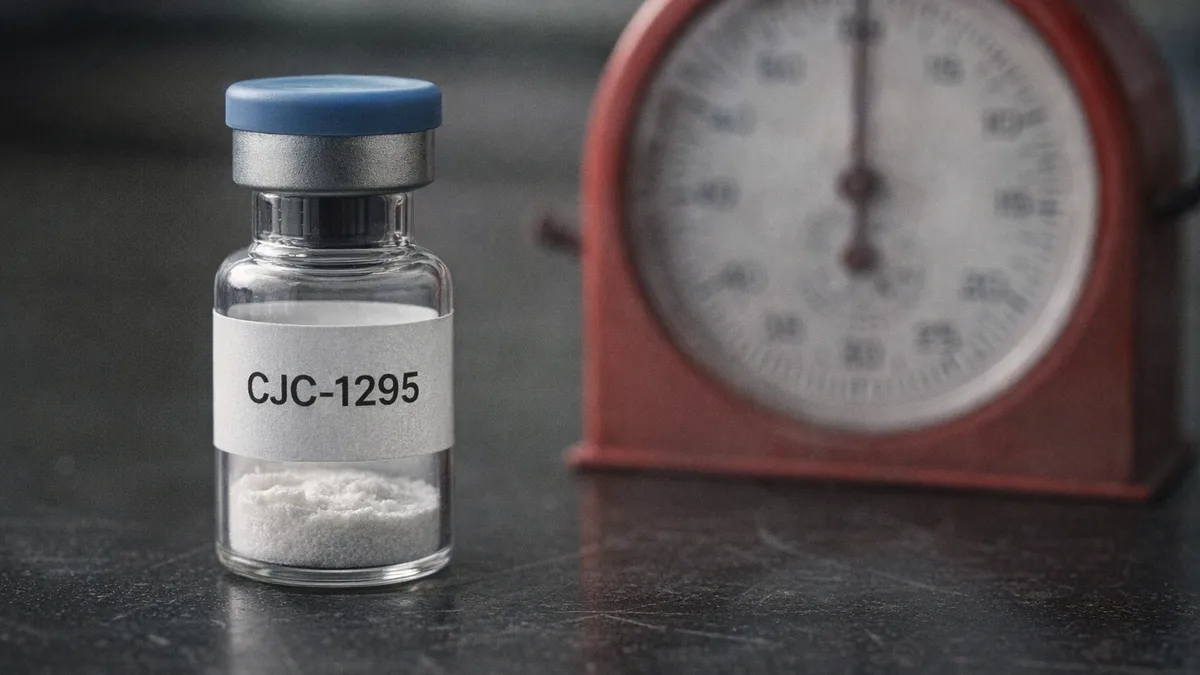
Evidence snapshot
A published pharmacokinetic/pharmacodynamic study (Teichman et al., 2006, Journal of Clinical Endocrinology & Metabolism) showed that CJC-1295 increased GH and IGF-1 levels in healthy subjects for up to 6 days after a single dose: this is the primary peer-reviewed human data.
CJC-1295 was developed by ConjuChem Biotechnologies using drug affinity complex (DAC) technology to bind albumin and extend half-life from minutes to days; clinical development was discontinued and the compound was never submitted to FDA for approval.
Two forms exist in community discussions: CJC-1295 with DAC (extended half-life) and CJC-1295 without DAC (modification GRF 1-29); both are research-use-only and not FDA-approved.
Commonly stacked with ipamorelin (a GHS) in online protocols based on the theoretical rationale of combining GHRH and GHS pathways; this combination has no FDA-approved clinical data.
Research record
What the evidence record says
- Evidence grade
- Not Graded
- Regulatory status
- CJC-1295 regulatory status has not been fully reviewed by Peptide Report editorial team. See company profiles and regulatory watch for current status.
- Also known as
- CJC-1295 DAC, CJC-1295 with drug affinity complex
Evidence records
Studies, registries, reviews, and regulatory records
Evidence review pending
- Detailed evidence review for CJC-1295 is pending editorial assessment. Current summary reflects available public records.
Records: Pharmacokinetics and Pharmacodynamics of CJC-1295, a Long-Acting GHRH Analog, FDA BPC-157 compounding safety risk: immunogenicity, Warning Letter: Gram Peptides
Evidence timeline
What changed, and when
Peptide Report last reviewed CJC-1295 on 2026-07-01.
Records: Pharmacokinetics and Pharmacodynamics of CJC-1295, a Long-Acting GHRH Analog
Direct answers
Frequently asked questions
What is CJC-1295?
CJC-1295 is a growth hormone-releasing hormone (ghrh) analog peptide tracked by Peptide Report. See the full profile for current editorial assessment.
Open research questions
What is still unknown
- What is the complete human evidence base for CJC-1295?
- What are the long-term safety considerations for CJC-1295?
Tracked claims
CJC-1295 increases GH and IGF-1 levels in humans based on published pharmacokinetic data.
Evidence level: Peer reviewed
Sources: Pharmacokinetics and Pharmacodynamics of CJC-1295, a Long-Acting GHRH Analog
How to read this: Cite the Teichman et al. (2006) JCEM publication directly. The study was a single-dose pharmacokinetic study in healthy volunteers, not a clinical outcomes trial. Do not extrapolate to efficacy claims.
CJC-1295 was discontinued by its developer and is not FDA-approved.
Evidence level: Primary regulatory
Sources: FDA BPC-157 compounding safety risk: immunogenicity, Warning Letter: Gram Peptides
How to read this: ConjuChem discontinued development; no FDA approval record exists. Products sold as 'research use only' are subject to FDA enforcement.
The CJC-1295 + ipamorelin stack is one of the most discussed peptide combinations online.
Evidence level: Community discussion
Sources: Warning Letter: Gram Peptides
How to read this: This combination is based on theoretical synergy between GHRH and GHS pathways but lacks clinical trial data for the combination. Track as a community protocol pattern.
Free report
Get the source-quality checklist
Use the same checklist Peptide Report uses to separate CJC-1295 (with DAC) claims, source records, supplier documentation, and media signals.
V1 collects email, role, and topic interest only. No medication, health-condition, dosing, or current-use data is collected in this form.
Formspree processes this submission for Peptide Report. Privacy notice.
Sources on this page
Each source record is linked to the claim or evidence note it supports.
Pharmacokinetics and Pharmacodynamics of CJC-1295, a Long-Acting GHRH Analog
Teichman et al. (2006) pharmacokinetic study (PMID 16569233) showing that CJC-1295 increased GH and IGF-1 levels in healthy subjects for up to 6 days after a single dose. The primary published human data for CJC-1295.
7 linked pagesOpen original ·
pubmed-cjc1295-pharmacokinetics-2006Certain bulk drug substances for use in compounding may present significant safety risks
FDA risk page lists BPC-157: compounded BPC-157 may pose immunogenicity risk and peptide-related impurity concerns for certain routes of administration.
41 linked pagesOpen original ·
fda-bulk-risk-listWarning Letter: Gram Peptides
FDA warning letter discussing peptide products marketed online and the limits of research-use-only positioning.
35 linked pagesOpen original ·
fda-gram-peptides-warning-2026Related compounds
CJC-1295 (no DAC)
CJC-1295 without DAC (Mod GRF 1-29) is a tetrasubstituted GHRH 1-29 analog with a half-life of approximately 30 minutes....
Evidence reviewIpamorelin
Ipamorelin is a synthetic pentapeptide growth hormone secretagogue (GHS) that stimulates GH release via ghrelin receptor...
Evidence reviewMK-677 (Ibutamoren)
MK-677 (ibutamoren) is a non-peptide, orally active growth hormone secretagogue developed by Merck that mimics ghrelin t...
Evidence reviewSermorelin
Sermorelin is a synthetic N-terminal fragment (1-29) of growth hormone-releasing hormone (GHRH) that was formerly FDA-ap...
Evidence reviewStay informed
Track CJC-1295 (with DAC) with Peptide Report
Get FDA Watch Alerts for CJC-1295 (with DAC)
Subscribe for regulatory updates, new trial data, and source-backed claim revisions.
Compare CJC-1295 (with DAC) with similar compounds
3 comparison pages available:
CJC-1295 + Ipamorelin vs Tesamorelin · CJC-1295 DAC vs No DAC · Sermorelin vs Tesamorelin