NAD+ is an essential cellular coenzyme, while NR and NMN are precursors marketed for healthy-aging claims. Human studies show that these precursors can raise NAD-related biomarkers, but results for insulin sensitivity, body composition, and physical function are inconsistent. No human lifespan benefit has been established.
Longevity supplement
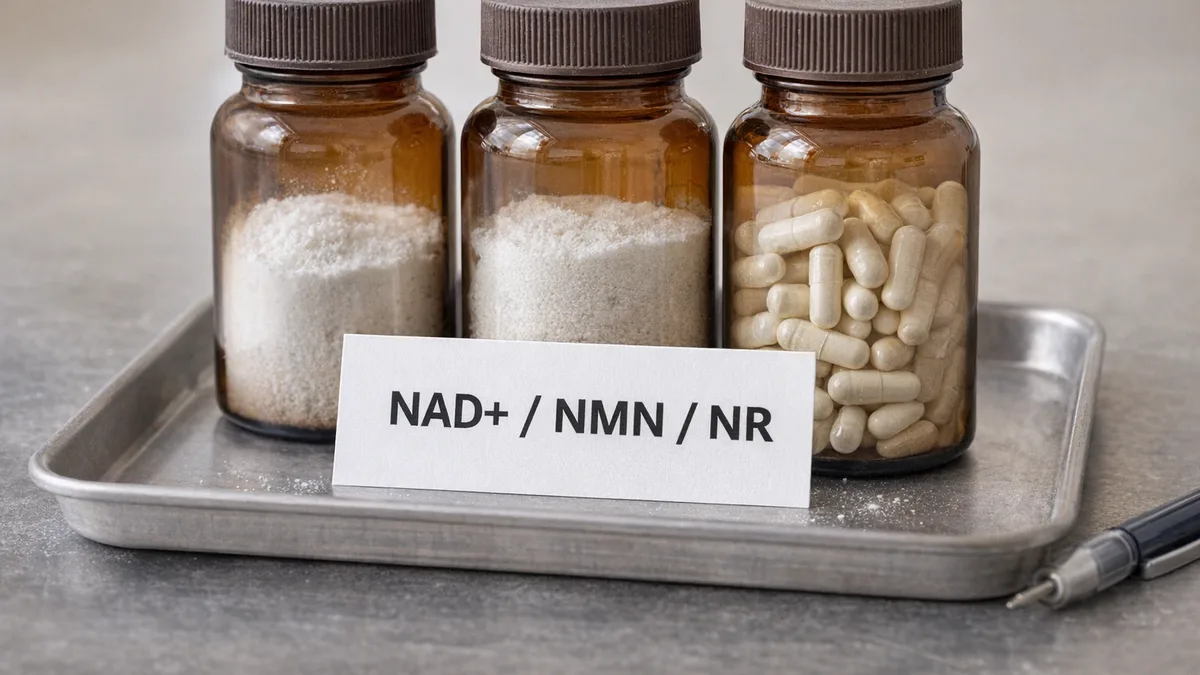
NAD+ / NMN / NR
NAD+ is an essential cellular coenzyme, while NR and NMN are precursors marketed for healthy-aging claims. Human studies show that these precursors can raise NAD-related biomarkers, but results for insulin sensitivity, body composition, and physical function are inconsistent. No human lifespan benefit has been established.
Regulatory watch
Last reviewed Jul 1, 2026
Next review Jul 29, 2026
Evidence snapshot
NAD+ is an essential coenzyme that declines with age in multiple tissues. Foundational reviews (Imai & Guarente, 2010; Verdin et al., 2016) link NAD+ decline to reduced sirtuin activity and propose precursor supplementation as a strategy to address aging biology.
Nicotinamide riboside (NR) has FDA GRAS (Generally Recognized As Safe) status (GRN 733, 2016) and is sold as a dietary supplement, most prominently as Tru Niagen. Human trials show NR reliably raises blood NAD+.
NMN (nicotinamide mononucleotide) is subject to an FDA determination that it is excluded from the dietary supplement definition under DSHEA because it was first authorized for investigation as a new drug. This has caused marketplace disruption, with some retailers withdrawing NMN products.
A randomized controlled trial showed NMN increased muscle insulin sensitivity in prediabetic women (Yoshino et al., Science, 2021). However, a 12-week NR trial in obese men raised NAD+ but did not improve insulin sensitivity or body composition (Dollerup et al., 2018), illustrating the gap between biomarker and clinical outcomes.
No human lifespan or healthspan outcome trial has been completed for NR or NMN. Preclinical mouse studies (Mills et al., 2017) showed NMN mitigated age-related physiological decline but did not demonstrate lifespan extension.
Research record
What the evidence record says
- Evidence grade
- Not Graded
- Regulatory status
- NAD+ / NMN / NR regulatory status has not been fully reviewed by Peptide Report editorial team. See company profiles and regulatory watch for current status.
Evidence records
Studies, registries, reviews, and regulatory records
Evidence review pending
- Detailed evidence review for NAD+ / NMN / NR is pending editorial assessment. Current summary reflects available public records.
Records: NAD+ and sirtuins in aging and disease (review), NAD+ in aging, metabolism, and neurodegeneration, FDA GRAS Notice No. 733: Nicotinamide Riboside (NR)
Evidence timeline
What changed, and when
Peptide Report last reviewed NAD+ / NMN / NR on 2026-07-01.
Direct answers
Frequently asked questions
What is NAD+ / NMN / NR?
NAD+ / NMN / NR is a longevity supplement tracked by Peptide Report. See the full profile for current editorial assessment.
Open research questions
What is still unknown
- What is the complete human evidence base for NAD+ / NMN / NR?
- What are the long-term safety considerations for NAD+ / NMN / NR?
Tracked claims
NAD+ levels decline with age, and supplementation with NR or NMN raises blood NAD+ in humans.
Evidence level: Peer reviewed
Sources: NAD+ and sirtuins in aging and disease (review), NAD+ in aging, metabolism, and neurodegeneration, A randomized placebo-controlled clinical trial of nicotinamide riboside in obese men
How to read this: Biomarker increases are well established. Do not equate raised NAD+ with proven clinical benefit.
NMN improved muscle insulin sensitivity in prediabetic women in a randomized controlled trial.
Evidence level: Peer reviewed
Sources: Nicotinamide mononucleotide increases muscle insulin sensitivity in prediabetic women
How to read this: Cite the Yoshino et al. (2021) trial. Note that the effect was seen in a specific subgroup (prediabetic women) and requires replication. It is not a lifespan outcome.
NR is FDA-GRAS and legally sold as a dietary supplement; NMN is subject to an FDA DSHEA exclusion determination.
Evidence level: Primary regulatory
Sources: FDA GRAS Notice No. 733: Nicotinamide Riboside (NR), FDA response to NMN DSHEA exclusion question
How to read this: This is the key regulatory distinction. The FDA NMN/DSHEA determination is the reason this page is classified as 'Regulatory watch.' Re-check the FDA advisory list on each review cycle.
NMN and NR are heavily promoted for longevity by David Sinclair and other researchers, with significant consumer market growth.
Evidence level: Community discussion
Sources: NAD+ in aging, metabolism, and neurodegeneration, Long-Term Administration of Nicotinamide Mononucleotide Mitigates Age-Related Physiological Decline in Mice, ClinicalTrials.gov search: Nicotinamide Mononucleotide (NMN) human trials
How to read this: Track as high-attention consumer signal. David Sinclair's prominence amplifies public interest, but his advocacy is distinct from the published clinical evidence base. Preclinical mouse data does not establish human benefit.
Free report
Get the source-quality checklist
Use the same checklist Peptide Report uses to separate NAD+ / NMN / NR claims, source records, supplier documentation, and media signals.
V1 collects email, role, and topic interest only. No medication, health-condition, dosing, or current-use data is collected in this form.
Formspree processes this submission for Peptide Report. Privacy notice.
Sources on this page
Each source record is linked to the claim or evidence note it supports.
NAD+ and sirtuins in aging and disease (review)
Foundational review (Imai & Guarente) describing how NAD+ links metabolism to sirtuin activity, and proposing NAD+ decline as a driver of aging biology.
1 linked pageOpen original ·
nad-pmc-imai-2010-sirtuinsNAD+ in aging, metabolism, and neurodegeneration
High-profile review (Verdin et al., including David Sinclair as a co-author) describing the decline of NAD+ with age and the rationale for supplementation with precursors (NR, NMN).
1 linked pageOpen original ·
elens-sinclair-2016-nad-agingFDA GRAS Notice No. 733: Nicotinamide Riboside (NR)
FDA GRAS (Generally Recognized As Safe) notice response for nicotinamide riboside (NR) chloride, the ingredient in Tru Niagen, supporting its use as a dietary supplement ingredient.
4 linked pagesOpen original ·
niagen-gras-fda-2016FDA response to NMN DSHEA exclusion question
FDA determination that NMN (nicotinamide mononucleotide) is excluded from the dietary supplement definition under DSHEA because it was first authorized for investigation as a new drug. This triggered marketplace disruption for NMN supplements.
4 linked pagesOpen original ·
fda-nmn-dshea-determination-2022ClinicalTrials.gov search: Nicotinamide Mononucleotide (NMN) human trials
ClinicalTrials.gov search showing registered interventional trials of NMN in human subjects, including studies of NAD+ biomarkers, insulin sensitivity, and physical function in older adults.
1 linked pageOpen original ·
clinicaltrials-gov-nmn-humanNicotinamide mononucleotide increases muscle insulin sensitivity in prediabetic women
Randomized, placebo-controlled trial (Yoshino et al., including Shin-ichiro Imai) showing that 10 weeks of NMN supplementation increased muscle insulin sensitivity in prediabetic women. A key human proof-of-concept study.
4 linked pagesOpen original ·
yoshino-2021-nmn-cellA randomized placebo-controlled clinical trial of nicotinamide riboside in obese men
Randomized, double-blind trial (Dollerup et al.) showing that NR safely increased blood NAD+ in obese men but did not improve insulin sensitivity or body composition over 12 weeks, illustrating the biomarker-vs-outcome gap.
4 linked pagesOpen original ·
dollerup-2018-nr-humanLong-Term Administration of Nicotinamide Mononucleotide Mitigates Age-Related Physiological Decline in Mice
Preclinical study (Mills et al., Sinclair lab) showing that 12 months of NMN administration mitigated age-related decline in multiple physiological parameters in mice, but no lifespan extension.
1 linked pageOpen original ·
sinclair-2017-nmn-lifespanRelated compounds
Metformin
Metformin is an FDA-approved medicine for type 2 diabetes. Longevity interest comes from biological mechanisms, observat...
Evidence reviewSpermidine
Spermidine is a naturally occurring dietary polyamine involved in cellular processes including autophagy. Animal studies...
Evidence reviewStay informed