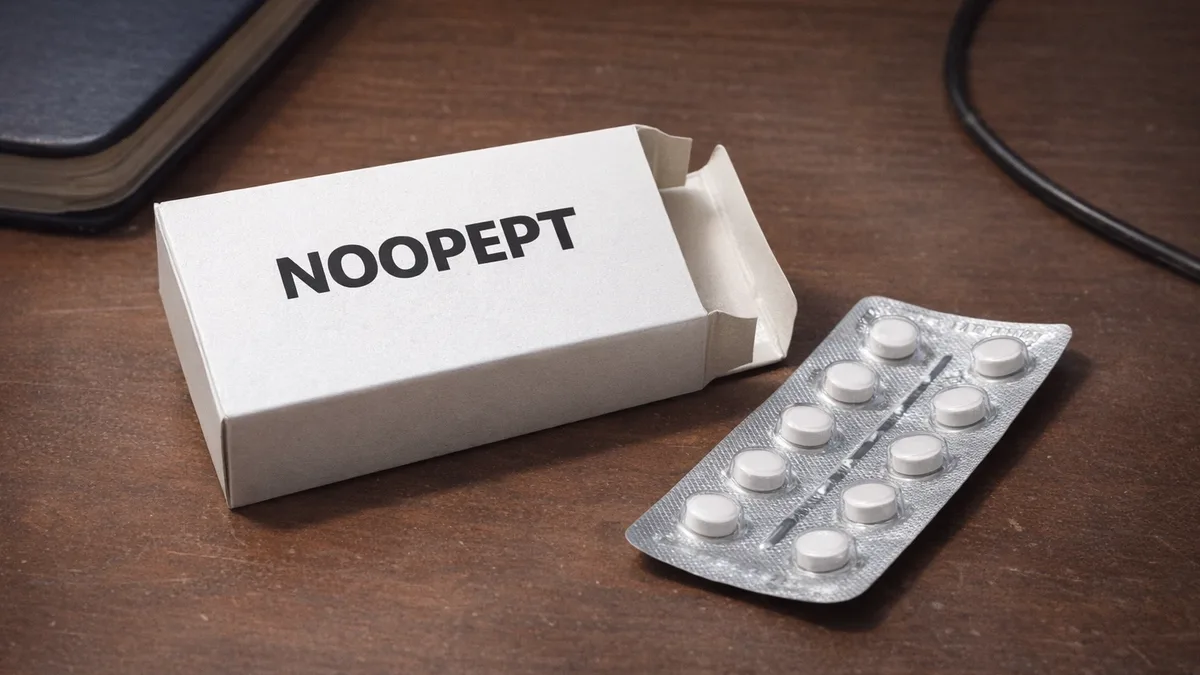
Noopept is a synthetic nootropic registered as a medicine in Russia for forms of cognitive impairment. The clinical record consists largely of small Russian-language studies with limited independent replication. It is sold in the United States without FDA drug approval.
Dipeptide nootropic / N-phenylacetyl-L-prolylglycine ethyl ester (cognitive enhancement)
Noopept
Noopept is a synthetic nootropic registered as a medicine in Russia for forms of cognitive impairment. The clinical record consists largely of small Russian-language studies with limited independent replication. It is sold in the United States without FDA drug approval.
Research watch: registered in Russia, sold as supplement in US
Last reviewed Jul 1, 2026
Next review Jul 29, 2026
Evidence snapshot
Noopept is registered as a pharmaceutical in Russia for mild cognitive impairment; Russian clinical trials include a 2011 study in stroke patients (PMID 22500312) and a 2008 EEG-characterized study of MCI patients (PMID 19008801), both published in Zhurnal Nevrologii i Psikhiatrii imeni S.S. Korsakova.
A 2025 physicochemical analysis in the Journal of Pharmaceutical and Biomedical Analysis confirmed the structural identity of Noopept as N-phenylacetyl-L-prolylglycine ethyl ester (PMID 40662561, DOI 10.1016/j.jpba.2024.116474).
A 2022 study in Neuroscience Letters found that Noopept's effects on CA1 pyramidal neurons involve α7 nicotinic acetylcholine receptors on hippocampal interneurons in rat brain slices (PMID 36195298, DOI 10.1016/j.neulet.2022.136898).
Noopept is sold as a dietary supplement in the United States without FDA drug approval. Russian clinical trials are small (dozens of patients), predominantly Russian-language, and have not been independently replicated in Western populations.
Research record
What the evidence record says
- Evidence grade
- Not Graded
- Regulatory status
- Noopept regulatory status has not been fully reviewed by Peptide Report editorial team. See company profiles and regulatory watch for current status.
Evidence records
Studies, registries, reviews, and regulatory records
Evidence review pending
- Detailed evidence review for Noopept is pending editorial assessment. Current summary reflects available public records.
Records: [Noopept in the treatment of mild cognitive impairment in patients with stroke]., [Clinical and electroencephalographic characteristic of noopept in patients with mild cognitive impairment of posttraumatic and vascular origin]., Physicochemical and structural analysis of N-phenylacetyl-L-prolylglycine ethyl ester (Noopept) - An active pharmaceutical ingredient with nootropic activity.
Evidence timeline
What changed, and when
Peptide Report last reviewed Noopept on 2026-07-01.
Records: [Noopept in the treatment of mild cognitive impairment in patients with stroke].
Direct answers
Frequently asked questions
What is Noopept?
Noopept is a dipeptide nootropic / n-phenylacetyl-l-prolylglycine ethyl ester (cognitive enhancement) tracked by Peptide Report. See the full profile for current editorial assessment.
Open research questions
What is still unknown
- What is the complete human evidence base for Noopept?
- What are the long-term safety considerations for Noopept?
Tracked claims
Noopept improves cognitive function in patients with mild cognitive impairment.
Evidence level: Peer reviewed: Russian clinical trials (limited)
Sources: [Noopept in the treatment of mild cognitive impairment in patients with stroke]., [Clinical and electroencephalographic characteristic of noopept in patients with mild cognitive impairment of posttraumatic and vascular origin].
How to read this: Two Russian clinical trials (PMID 22500312, 2011; PMID 19008801, 2008) studied Noopept in mild cognitive impairment from stroke and post-traumatic/vascular origins. These are small studies published in Russian-language journals without independent Western replication. Do not extrapolate to general cognitive enhancement in healthy individuals.
Noopept modulates cholinergic and neurotrophic pathways in the hippocampus.
Evidence level: Peer reviewed: preclinical
Sources: Effect of nootropic dipeptide noopept on CA1 pyramidal neurons involves α7AChRs on interneurons in hippocampal slices from rat., Cognitive Enhancer Noopept Activates Transcription Factor HIF-1.
How to read this: The 2022 Neuroscience Letters study (PMID 36195298) demonstrated α7 nAChR involvement on hippocampal interneurons in rats. The 2020 study (PMID 33119829) showed Noopept activates the transcription factor HIF-1. These are preclinical mechanisms only.
Noopept is a safe cognitive enhancer available as a supplement.
Evidence level: Community discussion
Sources: [Noopept in the treatment of mild cognitive impairment in patients with stroke]., Physicochemical and structural analysis of N-phenylacetyl-L-prolylglycine ethyl ester (Noopept) - An active pharmaceutical ingredient with nootropic activity.
How to read this: Noopept is registered as a drug in Russia but sold as an unregulated supplement in the US. The Russian clinical safety data is limited to small trials. No FDA-approved safety or efficacy data exists for the US supplement market. Track supplement marketing claims against the limited clinical evidence.
Free report
Get the source-quality checklist
Use the same checklist Peptide Report uses to separate Noopept claims, source records, supplier documentation, and media signals.
V1 collects email, role, and topic interest only. No medication, health-condition, dosing, or current-use data is collected in this form.
Formspree processes this submission for Peptide Report. Privacy notice.
Sources on this page
Each source record is linked to the claim or evidence note it supports.
[Noopept in the treatment of mild cognitive impairment in patients with stroke].
[Noopept in the treatment of mild cognitive impairment in patients with stroke].
4 linked pagesOpen original ·
pubmed-noopept-stroke-mci-2011[Clinical and electroencephalographic characteristic of noopept in patients with mild cognitive impairment of posttraumatic and vascular origin].
[Clinical and electroencephalographic characteristic of noopept in patients with mild cognitive impairment of posttraumatic and vascular origin].
3 linked pagesOpen original ·
pubmed-noopept-eeg-mci-2008Physicochemical and structural analysis of N-phenylacetyl-L-prolylglycine ethyl ester (Noopept) - An active pharmaceutical ingredient with nootropic activity.
Physicochemical and structural analysis of N-phenylacetyl-L-prolylglycine ethyl ester (Noopept) - An active pharmaceutical ingredient with nootropic activity.
3 linked pagesOpen original ·
pubmed-noopept-physicochemical-2025Effect of nootropic dipeptide noopept on CA1 pyramidal neurons involves α7AChRs on interneurons in hippocampal slices from rat.
Effect of nootropic dipeptide noopept on CA1 pyramidal neurons involves α7AChRs on interneurons in hippocampal slices from rat.
3 linked pagesOpen original ·
pubmed-noopept-hippocampal-achr-2022Cognitive Enhancer Noopept Activates Transcription Factor HIF-1.
Cognitive Enhancer Noopept Activates Transcription Factor HIF-1.
2 linked pagesOpen original ·
pubmed-noopept-hif1-2020Related compounds
Dihexa
Dihexa is an angiotensin IV analog studied for effects on the HGF/c-Met signaling system and synapse formation. The revi...
Research watch: preclinical onlySelank
Selank is a synthetic tuftsin analog developed and registered as a medicine in Russia. Its evidence base is dominated by...
Research watch: preclinical and limited Russian clinical useStay informed