Retatrutide is an investigational peptide that activates GIP, GLP-1, and glucagon receptors. In the 338-person Phase 2 obesity trial, the highest-dose group lost a mean 17.5% at 24 weeks and 24.2% at 48 weeks. Lilly later reported up to 28.3% mean loss at 80 weeks in the pivotal TRIUMPH-1 Phase 3 obesity trial. Retatrutide remains unapproved, and FDA says it cannot be used in compounding under federal law.
Investigational once-weekly peptide agonist of GIP, GLP-1, and glucagon receptors
Retatrutide
Retatrutide has produced large weight reductions in randomized Phase 2 and Phase 3 trials, but it remains unapproved. Long-term outcomes, direct comparisons, rare risks, durability, and final regulatory decisions remain unresolved.
Regulatory watch
Last reviewed Jul 12, 2026
Next review Aug 12, 2026
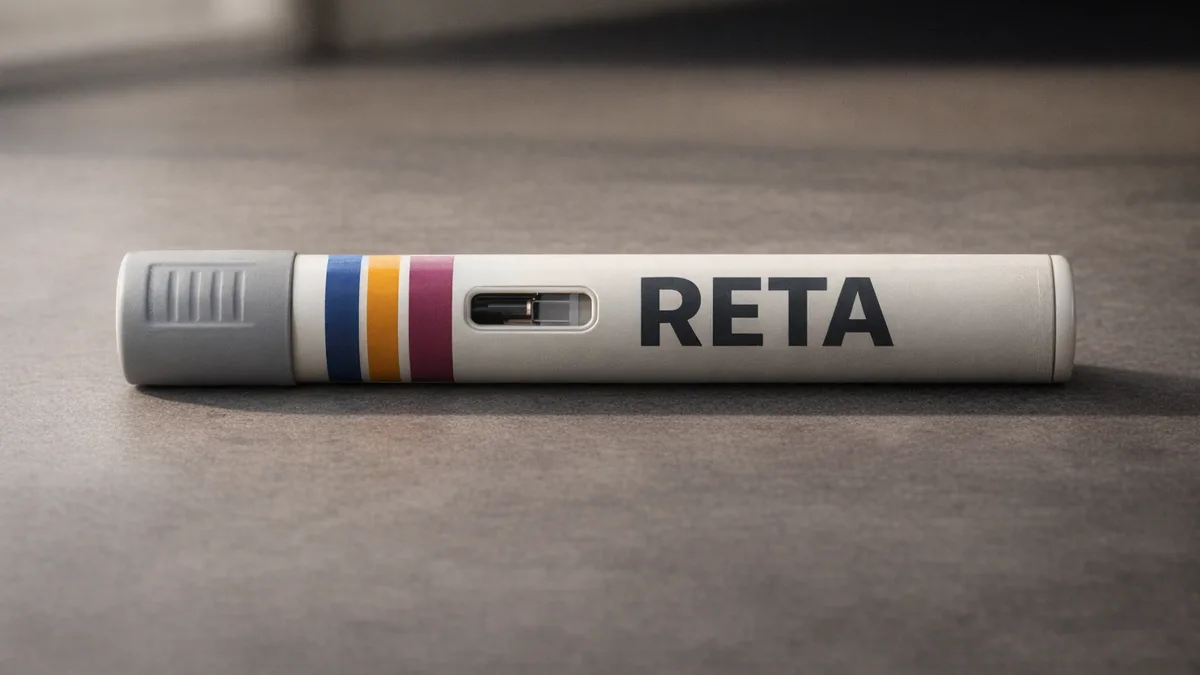
Evidence snapshot
Regulatory: no approval; FDA says it cannot be compounded and has not been found safe and effective for any condition.
Phase 2 obesity: 338 adults, 48 weeks, up to 24.2% mean loss at week 48.
Phase 3 obesity: TRIUMPH-1 reported up to 28.3% at week 80; full obesity publication was not yet peer-reviewed at the cutoff.
Phase 3 diabetes: TRANSCEND-T2D-1 was peer-reviewed in The Lancet and showed HbA1c and weight reductions at week 40.
Outcomes: cardiovascular and kidney outcomes remain under study.
Research record
What the evidence record says
- Evidence grade
- Human Phase 3 evidence
- Regulatory status
- Investigational and not approved by FDA, EMA, or any regulatory agency as of July 12, 2026. FDA states that retatrutide cannot be used in compounding under federal law.
- Also known as
- LY3437943
Evidence records
Studies, registries, reviews, and regulatory records
Phase 2 obesity, NEJM 2023
- 338 adults with obesity, or overweight plus a weight-related condition, without diabetes.
- Randomized, double-blind, placebo-controlled; all groups received lifestyle counseling.
- Primary endpoint was percent weight change at week 24.
- Week 24: −7.2%, −12.9%, −17.3%, and −17.5% across 1, 4, 8, and 12 mg versus −1.6% placebo.
- Week 48: −8.7%, −17.1%, −22.8%, and −24.2% versus −2.1% placebo.
- GI adverse effects were dose-related; heart rate rose dose-dependently to week 24 and declined at weeks 36 and 48.
- Limitations: Phase 2 size, 48 weeks, United States only, majority White, only 4% in the overweight category, no cardiovascular or mortality outcomes, sponsor funded.
Records: Retatrutide phase 2 results: 24.2% weight loss (NEJM)
TRIUMPH-1 Phase 3 obesity
- NCT05929066; 2,339 participants; randomized, double-blind, placebo-controlled.
- Sponsor-reported efficacy-estimand results at week 80: 4 mg −19.0%, 9 mg −25.9%, 12 mg −28.3%, placebo −2.2%.
- Selected extension: among baseline-BMI-at-least-35 participants who completed the main study and tolerated assigned medication, the 12 mg assignment reached −30.3% at week 104.
- Safety: nausea 28.6%, 38.4%, 42.4% versus 14.8% placebo; vomiting 10.6%, 22.8%, 25.3% versus 4.8%; dysesthesia 5.1%, 12.3%, 12.5% versus 0.9%; adverse-event discontinuation 4.1%, 6.9%, 11.3% versus 4.9%.
- Evidence label: Phase 3 randomized results presented at ADA and reported by sponsor; no full peer-reviewed obesity paper at cutoff.
Records: Lilly's triple agonist, retatrutide, delivered powerful weight loss in pivotal Phase 3 obesity trial., The First Phase 3 Obesity Study of Retatrutide in People with Obesity (TRIUMPH-1).
TRANSCEND-T2D-1 Phase 3
- NCT06354660; 537 adults with type 2 diabetes inadequately controlled by diet and exercise alone; 40 weeks; 48 sites in the US, Mexico, and India.
- Treatment-regimen HbA1c change: −1.69%, −1.86%, −1.94% versus −0.81% placebo.
- Treatment-regimen weight change: −11.5%, −13.9%, −15.3% versus −2.6% placebo.
- 91% completed treatment on study drug; discontinuation for adverse events was 2–5% versus 0%; no severe hypoglycemia.
- Two deaths occurred in the 4 mg group and were judged unrelated.
- Limitations: 40 weeks, relatively early and medication-naive diabetes, no cardiovascular-outcome conclusion; Lilly funded, with six employee/shareholder authors.
TRIUMPH-4
- NCT05931367; 445 adults with obesity or overweight and knee osteoarthritis.
- At 68 weeks Lilly reported −26.4% and −28.7% weight change for 9 and 12 mg versus −2.1% placebo.
- WOMAC pain improved, but percentage pain changes highlighted by Lilly were post hoc.
- Evidence label: sponsor-reported Phase 3 result without a full peer-reviewed paper at cutoff.
Evidence timeline
What changed, and when
Phase 2 obesity results were published, with week 24 as the primary endpoint and week 48 as a secondary endpoint.
Records: Retatrutide phase 2 results: 24.2% weight loss (NEJM)
The TRIUMPH Phase 3 obesity program began.
EMA agreed to a pediatric investigation plan for obesity; this was not marketing authorization.
Records: EMEA-003258-PIP02-23: retatrutide paediatric investigation plan.
Lilly announced positive TRIUMPH-4 Phase 3 topline results in obesity with knee osteoarthritis.
Lilly announced positive TRANSCEND-T2D-1 topline results.
Lilly announced positive TRIUMPH-1 pivotal obesity results.
TRANSCEND-T2D-1 was published in The Lancet and TRIUMPH-1 was presented at ADA.
Records: The First Phase 3 Obesity Study of Retatrutide in People with Obesity (TRIUMPH-1)., Efficacy and safety of retatrutide in people with type 2 diabetes and inadequate glycaemic control with diet and exercise (TRANSCEND-T2D-1): a double-blind, randomised, phase 3 trial.
Retatrutide remained investigational and unapproved.
Records: FDA's Concerns with Unapproved GLP-1 Drugs Used for Weight Loss., What to know about retatrutide.
Direct answers
Frequently asked questions
What receptors does retatrutide target?
It activates GIP, GLP-1, and glucagon receptors in a single investigational molecule.
Records: Retatrutide phase 2 results: 24.2% weight loss (NEJM)
Is retatrutide approved?
No. It remained unapproved by any regulatory agency as of July 12, 2026.
Records: FDA's Concerns with Unapproved GLP-1 Drugs Used for Weight Loss., What to know about retatrutide.
Can it legally be compounded?
FDA says retatrutide cannot be used in compounding under federal law.
Records: FDA's Concerns with Unapproved GLP-1 Drugs Used for Weight Loss.
What was the exact Phase 2 result?
At 12 mg, mean weight change was −17.5% at week 24 and −24.2% at week 48.
Records: Retatrutide phase 2 results: 24.2% weight loss (NEJM)
What did TRIUMPH-1 report?
Lilly reported −19.0%, −25.9%, and −28.3% at week 80 for 4, 9, and 12 mg in the efficacy estimand.
Is the 30.3% figure representative of everyone?
No. It came from a selected extension of baseline-BMI-at-least-35 participants who completed the main trial and tolerated treatment.
What adverse effects have appeared?
Gastrointestinal events were most common; dose-related dysesthesia and treatment discontinuation were also reported in Phase 3 obesity results.
Records: Retatrutide phase 2 results: 24.2% weight loss (NEJM), Lilly's triple agonist, retatrutide, delivered powerful weight loss in pivotal Phase 3 obesity trial., Efficacy and safety of retatrutide in people with type 2 diabetes and inadequate glycaemic control with diet and exercise (TRANSCEND-T2D-1): a double-blind, randomised, phase 3 trial.
Has it been compared directly with tirzepatide?
A direct-comparison trial is registered, but no completed result was identified at the cutoff.
Records: TRIUMPH-5: retatrutide compared with tirzepatide in adults with obesity.
Does an EMA pediatric plan mean European approval?
No. A pediatric investigation plan is a development requirement, not marketing authorization.
Records: EMEA-003258-PIP02-23: retatrutide paediatric investigation plan.
Open research questions
What is still unknown
- FDA and EMA review outcomes and final indications, if any.
- Full peer-reviewed TRIUMPH-1 and TRIUMPH-4 publications.
- Long-term cardiovascular, renal, mortality, gallbladder, pancreatic, psychiatric, nutritional, and reproductive outcomes.
- Rare adverse events after much larger exposure.
- Weight regain and metabolic outcomes after discontinuation.
- Lean-mass and bone effects during very large weight loss.
- Direct efficacy and tolerability versus tirzepatide.
- Durability beyond two years and performance in older or medically complex populations.
Tracked claims
Retatrutide is FDA-approved.
Evidence level: Contradicted by the cited record
Sources: FDA's Concerns with Unapproved GLP-1 Drugs Used for Weight Loss., What to know about retatrutide.
How to read this: It remains investigational.
Compounded retatrutide is legal because the molecule is in trials.
Evidence level: Contradicted by the cited record
Sources: FDA's Concerns with Unapproved GLP-1 Drugs Used for Weight Loss.
How to read this: FDA says retatrutide cannot be used in compounding under federal law.
Phase 2 produced 17.5% weight loss at 48 weeks.
Evidence level: Contradicted by the cited record
Sources: Retatrutide phase 2 results: 24.2% weight loss (NEJM)
How to read this: The 17.5% result was at week 24; the 12 mg week-48 result was 24.2%.
Retatrutide causes 30% weight loss.
Evidence level: Requires Major Qualification
How to read this: The 30.3% figure was sponsor-reported at week 104 in a selected extension of baseline-BMI-at-least-35 completers who tolerated treatment.
It produces bariatric-surgery-level results.
Evidence level: Promotional Comparison
How to read this: No randomized comparison with surgery was conducted, and durability, risks, and treatment context differ.
It burns fat because of glucagon agonism.
Evidence level: Mechanistic Simplification
Sources: Retatrutide phase 2 results: 24.2% weight loss (NEJM)
How to read this: Triple-receptor activity is established, but individual clinical effects cannot be assigned to one receptor from these trials.
Retatrutide is better than tirzepatide.
Evidence level: Not Yet Established Head To Head
Sources: TRIUMPH-5: retatrutide compared with tirzepatide in adults with obesity.
How to read this: TRIUMPH-5 is the relevant direct-comparison trial; no completed result was identified.
Retatrutide prevents heart attacks or kidney disease.
Evidence level: Premature
Sources: TRIUMPH-Outcomes: cardiovascular and kidney outcomes in adults living with obesity.
How to read this: The dedicated cardiovascular and kidney outcomes trial remains ongoing.
No plateau means weight loss will continue indefinitely.
Evidence level: Unsupported by the cited record
Sources: Lilly's triple agonist, retatrutide, delivered powerful weight loss in pivotal Phase 3 obesity trial., Efficacy and safety of retatrutide in people with type 2 diabetes and inadequate glycaemic control with diet and exercise (TRANSCEND-T2D-1): a double-blind, randomised, phase 3 trial.
How to read this: An observed trajectory inside a fixed trial does not establish indefinite continued loss.
Phase 3 proves long-term safety.
Evidence level: Overstated
Sources: Efficacy and safety of retatrutide in people with type 2 diabetes and inadequate glycaemic control with diet and exercise (TRANSCEND-T2D-1): a double-blind, randomised, phase 3 trial., TRIUMPH-Outcomes: cardiovascular and kidney outcomes in adults living with obesity.
How to read this: Rare events, lifetime use, and hard outcomes require larger and longer follow-up.
Linked public records
Regulatory actions involving Retatrutide
Gram Peptides: FDA Warning Letter 721806
Agency warning · Open public record
The FDA said Gram Peptides marketed unapproved new drugs for human use despite research-only labeling. Warning letter 721806 details the finding.
Companies: Gram Peptides
Compounds: Retatrutide, Tirzepatide
Free report
Get the source-quality checklist
Use the same checklist Peptide Report uses to separate Retatrutide claims, source records, supplier documentation, and media signals.
V1 collects email, role, and topic interest only. No medication, health-condition, dosing, or current-use data is collected in this form.
Formspree processes this submission for Peptide Report. Privacy notice.
Sources on this page
Each source record is linked to the claim or evidence note it supports.
Retatrutide for Obesity: A Phase 2 Trial
Retatrutide phase 2 obesity trial (NEJM 2023): at 12 mg, mean body weight fell 17.5% at week 24 and 24.2% at week 48; GI adverse events were most common.
12 linked pagesOpen original ·
nejm-retatrutide-phase2-2023FDA's Concerns with Unapproved GLP-1 Drugs Used for Weight Loss.
U.S. Food and Drug Administration. FDA's Concerns with Unapproved GLP-1 Drugs Used for Weight Loss. Accessed 2026-07-12.
11 linked pagesOpen original ·
research-reta-02What to know about retatrutide.
Eli Lilly and Company. What to know about retatrutide. Current 2026 status page.
1 linked pageOpen original ·
research-reta-03Lilly's triple agonist, retatrutide, delivered powerful weight loss in pivotal Phase 3 obesity trial.
Eli Lilly and Company. Lilly's triple agonist, retatrutide, delivered powerful weight loss in pivotal Phase 3 obesity trial. News release, 2026-05-21.
9 linked pagesOpen original ·
research-reta-04The First Phase 3 Obesity Study of Retatrutide in People with Obesity (TRIUMPH-1).
Eli Lilly and Company. The First Phase 3 Obesity Study of Retatrutide in People with Obesity (TRIUMPH-1). ADA Scientific Sessions presentation, 2026-06-06.
1 linked pageOpen original ·
research-reta-05Efficacy and safety of retatrutide in people with type 2 diabetes and inadequate glycaemic control with diet and exercise (TRANSCEND-T2D-1): a double-blind, randomised, phase 3 trial.
Bajaj HS, Welch M, Shah P, et al. Efficacy and safety of retatrutide in people with type 2 diabetes and inadequate glycaemic control with diet and exercise (TRANSCEND-T2D-1): a double-blind, randomised, phase 3 trial. Lancet. 2026;407(10546):2402-2413. doi:10.1016/S0140-6736(26)00967-0. PMID 42250575.
1 linked pageOpen original ·
research-reta-06TRIUMPH-Outcomes: cardiovascular and kidney outcomes in adults living with obesity.
ClinicalTrials.gov. TRIUMPH-Outcomes: cardiovascular and kidney outcomes in adults living with obesity. NCT06383390.
1 linked pageOpen original ·
research-reta-09EMEA-003258-PIP02-23: retatrutide paediatric investigation plan.
European Medicines Agency. EMEA-003258-PIP02-23: retatrutide paediatric investigation plan. Decision P/0336/2024, 2024-09-13.
1 linked pageOpen original ·
research-reta-08Retatrutide delivered weight loss of up to an average of 71.2 lbs along with substantial relief from osteoarthritis pain in first successful Phase 3 trial.
Eli Lilly and Company. Retatrutide delivered weight loss of up to an average of 71.2 lbs along with substantial relief from osteoarthritis pain in first successful Phase 3 trial. News release, 2025-12-11.
1 linked pageOpen original ·
research-reta-07Retatrutide demonstrated significant reductions in A1C and weight in first Phase 3 trial for treatment of type 2 diabetes.
Eli Lilly and Company. Retatrutide demonstrated significant reductions in A1C and weight in first Phase 3 trial for treatment of type 2 diabetes. News release, 2026-03-19.
1 linked pageOpen original ·
research-reta-10TRIUMPH-5: retatrutide compared with tirzepatide in adults with obesity.
ClinicalTrials.gov. TRIUMPH-5: retatrutide compared with tirzepatide in adults with obesity. NCT06662383.
1 linked pageOpen original ·
research-reta-11Related compounds
Semaglutide
Semaglutide is a GLP-1 receptor agonist sold as Ozempic, Wegovy, and Rybelsus for specific FDA-approved indications. Ran...
Evidence reviewTirzepatide
Tirzepatide is a dual GIP and GLP-1 receptor agonist sold as Mounjaro and Zepbound for specific FDA-approved indications...
Evidence reviewStay informed
Track Retatrutide with Peptide Report
Get FDA Watch Alerts for Retatrutide
Subscribe for regulatory updates, new trial data, and source-backed claim revisions.
See claims about Retatrutide fact-checked
7 video claims checked in our video claim scanner.
Compare Retatrutide with similar compounds
1 comparison page available:
Retatrutide vs Tirzepatide