The human record is extremely limited. Two registered trials exist: a Phase 1 safety and pharmacokinetics study (NCT02637284) with no posted results, and a Phase 2 hamstring-strain trial (NCT07437547) still recruiting. Published human data derive from fewer than 30 subjects across three uncontrolled reports. Nearly all positive findings come from preclinical rodent and in-vitro work, much of it from a single research group in Zagreb. A 2025 systematic review of 544 records found 35 preclinical and only 1 clinical study, and identified no clinical safety data.
Research peptide
BPC-157
BPC-157 is an experimental peptide with extensive animal research but very limited human evidence. A Phase 1 registry record has no posted efficacy result, and a small uncontrolled knee-pain report does not establish benefit. It is not FDA-approved and is prohibited in sport.
Regulatory watch
Last reviewed Jul 28, 2026
Next review Jul 24, 2026
Evidence snapshot
Human trial record: a Phase 1 safety and pharmacokinetics registry entry has no posted efficacy result.
Clinical report: a small retrospective knee-pain series used telephone follow-up and had no control group.
Regulatory status: BPC-157 is not FDA-approved and was scheduled for FDA advisory committee discussion in July 2026.
Sport status: USADA identifies BPC-157 as an experimental peptide prohibited under anti-doping rules.
Context map
Three evidence layers that answer different questions
A rodent ulcer model, a supplier vial listing, and a recovery anecdote are not interchangeable. Each layer below has its own source type and limit.
-
Studied context
Two registered trials and three small uncontrolled human reports
The controlled human record is a Phase 1 safety/PK trial with no posted results and a Phase 2 hamstring trial still recruiting. The published human reports are small and uncontrolled. Preclinical studies in rodents describe anti-ulcer, wound-healing, and organ-protective effects.
- Phase 1 registry record NCT02637284 (sponsor PharmaCotherapia) studied oral safety and pharmacokinetics; no results were ever posted.
- Phase 2 trial NCT07437547 (Hudson Biotech) is recruiting for acute hamstring strain; estimated primary completion 2027.
- Three small uncontrolled human publications cover fewer than 30 subjects total and use no standardized pharmaceutical preparation.
- A 2025 systematic review of 544 records found 35 preclinical and 1 clinical study, with no clinical safety data.
Study records: PCO-02 safety and pharmacokinetics trial, Pentadecapeptide BPC 157 for Acute Grade II Hamstring Strain (NCT07437547), Intra-articular injection of BPC 157 for multiple types of knee pain, Safety of Intravenous Infusion of BPC157 in Humans: A Pilot Study, Emerging Use of BPC-157 in Orthopaedic Sports Medicine: A Systematic Review, A new gastric juice peptide, BPC, and characterization of its 15 amino acid fragment BPC 157, BPC-157 protection against gastric and duodenal lesions in rat ulcer models
Evidence boundary: These records do not test the vial, capsule, nasal-spray, and topical formats observed in the research-use market, and the preclinical findings do not establish human efficacy for any indication.
-
Observed market presentation
Vials, capsules, nasal sprays, topicals, and blends in research-use catalogs
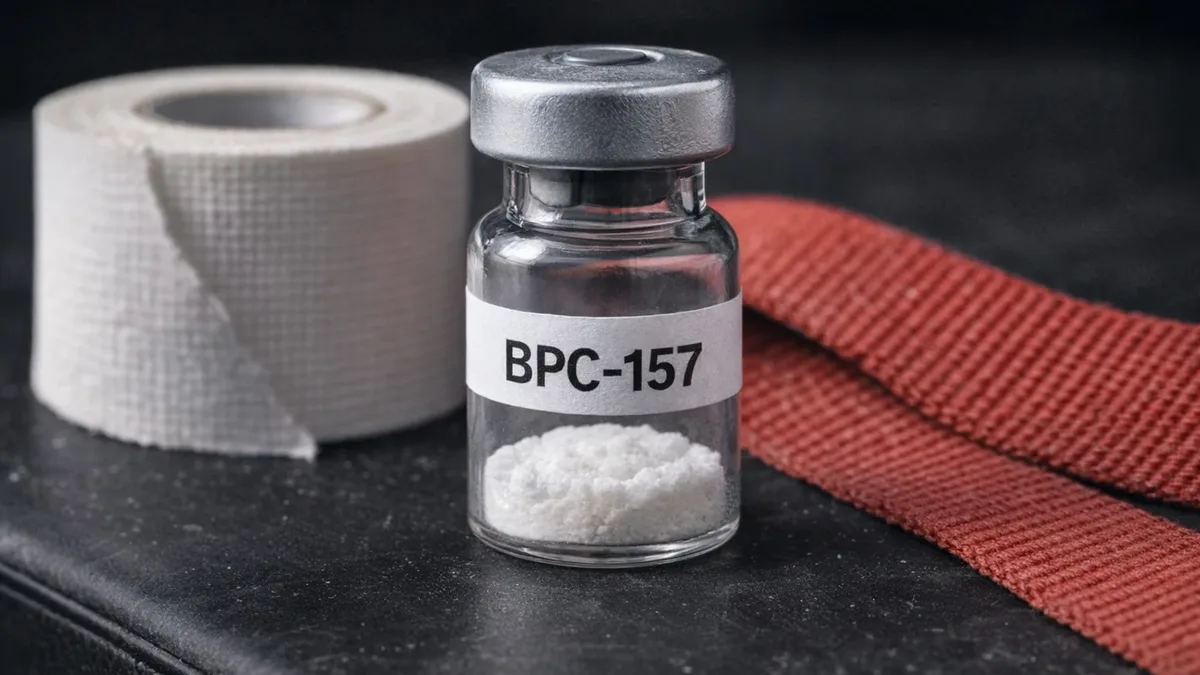
BPC-157 appears in research-use-only catalogs as lyophilized powder vials, capsules and tablets, nasal sprays, topical creams, and blends. A vial is packaging, not proof of a subcutaneous route. A catalog listing records only that the listing was observed.
- Lyophilized powder vials are the most common presentation across observed suppliers.
- Capsules, tablets, nasal sprays, topical creams, and multi-compound blends are also listed.
- Some suppliers publish batch certificates of analysis naming an independent laboratory; others gate certificates behind a lot-number lookup or leave the certificate tab empty.
- No observed presentation matches an approved or clinically-studied formulation.
- Product listings
- 6
- Testing records
- 4
- Observed formats
- Single-compound vials, Combination vials
- Lab-issued, supplier-hosted3
- Supplier reproduction1
Inspect the linked testing records
Evidence boundary: Catalog records are market observations only. They are not evidence of identity, safety, efficacy, quality, current inventory, or independent testing, and a published certificate is a supplier-provided document.
-
Anecdotal and media signal
Recovery and healing claims circulating in video and community content
Video and community content frequently frames BPC-157 as a recovery, gut-healing, or anti-injury compound. These are claim patterns and personal reports, not clinical evidence.
- Recovery, tendon, gut, and injury-prevention themes recur in creator content.
- Community claims often extrapolate rodent findings to human athletic use.
- Peptide Report fact-checks selected claims and labels them as unverified where no human trial supports them.
7 claims tracked across 3 video reviews
Physician discussion of BPC-157 evidencePeptide safety discussionCreator peptide safety episodeEvidence boundary: Community and video claims are discovery signals only. They do not establish safety, efficacy, prevalence, or product identity, and they never raise the evidence grade.
Research record
What the evidence record says
- Evidence grade
- Limited human evidence
- Regulatory status
- BPC-157 is not an FDA-approved drug anywhere and has no approved formulation. On FDA's compounding safety-risk page it appears in the nominated-but-withdrawn table; FDA cites potential immunogenicity for certain routes and complexities with peptide-related impurities and API characterization, and reports no or only limited safety information. It was re-reviewed at the July 23-24, 2026 Pharmacy Compounding Advisory Committee for ulcerative colitis; the vote outcome was pending at last check. WADA prohibits BPC-157 at all times under S0 Non-Approved Substances, naming it explicitly.
- Also known as
- Bepecin, BPC 157, Body Protection Compound 157, Pentadecapeptide BPC-157, PCO-02
Evidence records
Studies, registries, reviews, and regulatory records
Registered human trials
- NCT02637284 is a Phase 1 oral safety and pharmacokinetics study in healthy volunteers; no results were posted.
- NCT07437547 is a Phase 2 randomized, double-blind, placebo-controlled hamstring-strain trial recruiting with estimated primary completion in 2027.
- No randomized, placebo-controlled efficacy data in humans exists for any indication.
Records: PCO-02 safety and pharmacokinetics trial, Pentadecapeptide BPC 157 for Acute Grade II Hamstring Strain (NCT07437547)
Published human reports
- A 2021 retrospective knee-pain series followed 17 patients by telephone with no control group.
- A 2025 two-participant intravenous pilot reported no measured biomarker changes; it is not an efficacy trial.
- Published human data derive from fewer than 30 subjects across three uncontrolled reports.
Records: Intra-articular injection of BPC 157 for multiple types of knee pain, Safety of Intravenous Infusion of BPC157 in Humans: A Pilot Study
Preclinical findings
- Rodent studies describe anti-ulcer, wound-healing, hepatoprotective, and tendon-to-bone healing effects.
- Much of the preclinical literature originates from a single research group in Zagreb.
- A 2025 systematic review found improved structural and biomechanical outcomes in animal injury models but no clinical safety data.
Records: BPC-157 protection against gastric and duodenal lesions in rat ulcer models, Emerging Use of BPC-157 in Orthopaedic Sports Medicine: A Systematic Review
Regulatory and sport status
- BPC-157 is not FDA-approved and has no approved formulation.
- FDA cites potential immunogenicity and impurity/characterization concerns for compounded BPC-157.
- WADA prohibits BPC-157 at all times under S0 Non-Approved Substances.
Records: FDA BPC-157 compounding safety risk: immunogenicity, WADA Prohibited List: S0 Non-Approved Substances, FDA compounding advisory committee July 2026: peptides
Evidence timeline
What changed, and when
Sikiric and colleagues characterize BPC-157 as a 15-amino-acid fragment of a larger gastric-juice peptide.
Records: A new gastric juice peptide, BPC, and characterization of its 15 amino acid fragment BPC 157
Phase 1 safety and pharmacokinetics trial NCT02637284 is registered; no results are posted.
A small retrospective, uncontrolled knee-pain report describes telephone follow-up of 17 patients.
Records: Intra-articular injection of BPC 157 for multiple types of knee pain
FDA places BPC-157 in Category 2 of the 503A interim compounding policy; the nomination is later withdrawn by the nominator.
Records: FDA BPC-157 compounding safety risk: immunogenicity
A systematic review of 544 records finds 35 preclinical and 1 clinical study and identifies no clinical safety data.
Records: Emerging Use of BPC-157 in Orthopaedic Sports Medicine: A Systematic Review
FDA's Pharmacy Compounding Advisory Committee re-reviews BPC-157 bulk substances for ulcerative colitis; a Phase 2 hamstring trial begins recruiting.
Records: FDA compounding advisory committee July 2026: peptides, Pentadecapeptide BPC 157 for Acute Grade II Hamstring Strain (NCT07437547)
Direct answers
Frequently asked questions
Is BPC-157 FDA-approved?
No. BPC-157 is not an FDA-approved drug in any form, and no approved formulation exists.
Records: FDA BPC-157 compounding safety risk: immunogenicity
What human evidence exists for BPC-157?
Two registered trials (one Phase 1 with no posted results, one Phase 2 still recruiting) and three small uncontrolled reports covering fewer than 30 subjects total. There are no randomized, placebo-controlled efficacy data in humans.
Records: PCO-02 safety and pharmacokinetics trial, Pentadecapeptide BPC 157 for Acute Grade II Hamstring Strain (NCT07437547), Intra-articular injection of BPC 157 for multiple types of knee pain
Is BPC-157 prohibited in sport?
Yes. WADA prohibits BPC-157 at all times under S0 Non-Approved Substances and names it explicitly.
Records: WADA Prohibited List: S0 Non-Approved Substances, BPC-157: Experimental peptide prohibited in sport
Do the animal studies prove it works in humans?
No. The positive findings are preclinical rodent and in-vitro results. A 2025 systematic review found no clinical safety data and only one clinical study, so animal findings do not establish human efficacy.
Records: Emerging Use of BPC-157 in Orthopaedic Sports Medicine: A Systematic Review, BPC-157 protection against gastric and duodenal lesions in rat ulcer models
What forms does BPC-157 appear in online?
Observed research-use catalogs list lyophilized powder vials, capsules and tablets, nasal sprays, topical creams, and blends. A vial is packaging, not proof of a route, and a listing is not evidence of quality or testing.
Records: Valar Peptides: bpc 157 5mg, Stemcode Peptides: bpc 157 nasal spray
What is the current FDA compounding status?
BPC-157 appears in FDA's nominated-but-withdrawn table for bulk compounding substances, with FDA citing immunogenicity and impurity concerns. It was re-reviewed at the July 2026 Pharmacy Compounding Advisory Committee.
Records: FDA BPC-157 compounding safety risk: immunogenicity, FDA compounding advisory committee July 2026: peptides
Open research questions
What is still unknown
- No published human pharmacokinetics from a controlled trial exists; the Phase 1 PK trial never posted results.
- The plasma half-life under 30 minutes does not explain purported effects lasting hours to days.
- No validated pharmaceutical formulation, excipient, or compatibility data exists.
- No randomized, placebo-controlled efficacy data in humans exists for any indication.
- Immunogenicity, impurity, and API-characterization risks remain uncharacterized.
- Long-term safety, carcinogenicity, and reproductive effects are unknown in humans.
- The July 2026 FDA advisory committee vote outcome for ulcerative colitis was pending at last check.
Tracked claims
The reviewed human records do not establish that BPC-157 improves injury recovery or pain.
Evidence level: Limited human evidence
Sources: PCO-02 safety and pharmacokinetics trial, Intra-articular injection of BPC 157 for multiple types of knee pain
How to read this: The registry record has no efficacy result, and the published knee report is retrospective, uncontrolled, and based on telephone follow-up.
BPC-157 is not FDA-approved and remains under active compounding-policy review.
Evidence level: Primary regulatory
Sources: FDA compounding advisory committee July 2026: peptides, FDA BPC-157 compounding safety risk: immunogenicity
How to read this: An advisory committee proceeding is part of a regulatory process. It does not establish approval, safety, or efficacy.
BPC-157 is prohibited in sport under anti-doping rules.
Evidence level: Sports regulation
Sources: BPC-157: Experimental peptide prohibited in sport
How to read this: Sports-prohibition status is separate from FDA approval and clinical evidence.
Linked public records
Regulatory actions involving BPC-157
FDA advisory committee to review seven peptide-related bulk drug substances
Scheduled · Scheduled public meeting
FDA scheduled a two-day Pharmacy Compounding Advisory Committee meeting to discuss whether BPC-157, KPV, TB-500, MOTS-c, emideltide/DSIP, Semax, and Epitalon-related substances should be included on the 503A Bulks List. The committee provides advice; the meeting itself is not a final agency determination.
Compounds: BPC-157, KPV, TB-500, MOTS-c, DSIP, Semax, Epitalon
Free report
Get the source-quality checklist
Use the same checklist Peptide Report uses to separate BPC-157 claims, source records, supplier documentation, and media signals.
V1 collects email, role, and topic interest only. No medication, health-condition, dosing, or current-use data is collected in this form.
Formspree processes this submission for Peptide Report. Privacy notice.
Sources on this page
Each source record is linked to the claim or evidence note it supports.
July 23-24, 2026 Pharmacy Compounding Advisory Committee meeting
FDA Pharmacy Compounding Advisory Committee meeting notice for July 23 to 24, 2026, scheduling peptide bulk substances for discussion.
23 linked pagesOpen original ·
fda-pcac-july-2026Certain bulk drug substances for use in compounding may present significant safety risks
FDA risk page lists BPC-157: compounded BPC-157 may pose immunogenicity risk and peptide-related impurity concerns for certain routes of administration.
41 linked pagesOpen original ·
fda-bulk-risk-listWarning Letter: Gram Peptides
FDA warning letter discussing peptide products marketed online and the limits of research-use-only positioning.
35 linked pagesOpen original ·
fda-gram-peptides-warning-2026PCO-02 safety and pharmacokinetics trial
Registry record for a Phase 1 safety and pharmacokinetics study associated with BPC-157. The record status is unknown and no efficacy result is posted.
6 linked pagesOpen original ·
clinicaltrials-bpc157-pco02Intra-articular injection of BPC 157 for multiple types of knee pain
Small retrospective, uncontrolled knee-pain report based on telephone follow-up. It does not establish efficacy.
6 linked pagesOpen original ·
pubmed-bpc157-knee-series-2021BPC-157: Experimental peptide prohibited in sport
USADA reference describing BPC-157 regulatory and sport-prohibition status.
3 linked pagesOpen original ·
usada-bpc157-statusEmerging Use of BPC-157 in Orthopaedic Sports Medicine: A Systematic Review
Systematic review of 544 records (1993-2024) found 36 met inclusion: 35 preclinical and 1 clinical. Reports improved structural and biomechanical outcomes in animal muscle, tendon, ligament, and bone injury models. No clinical safety data identified.
1 linked pageOpen original ·
pubmed-bpc157-systematic-review-2025WADA Prohibited List: S0 Non-Approved Substances
S0 Non-Approved Substances prohibits at all times any pharmacological substance with no current governmental approval for human therapeutic use, explicitly naming BPC-157 among examples.
1 linked pageOpen original ·
wada-bpc157-prohibited-listPentadecapeptide BPC 157 for Acute Grade II Hamstring Strain (NCT07437547)
Phase 2 randomized, double-blind, placebo-controlled trial sponsored by Hudson Biotech, 120 planned participants, recruiting with estimated primary completion 2027. No results posted.
1 linked pageOpen original ·
clinicaltrials-bpc157-hamstring-2026A new gastric juice peptide, BPC, and characterization of its 15 amino acid fragment BPC 157
Original characterization of BPC-157 as a 15-amino-acid fragment of a larger gastric-juice peptide by Sikiric and colleagues.
1 linked pageOpen original ·
pubmed-bpc157-gastric-pentadecapeptide-1993BPC-157 protection against gastric and duodenal lesions in rat ulcer models
Preclinical rat study by Sikiric and colleagues reporting BPC-157 was effective across restraint-stress, cysteamine, ethanol, indomethacin, and capsaicin ulcer models.
1 linked pageOpen original ·
pubmed-bpc157-ulcer-preclinical-1994Safety of Intravenous Infusion of BPC157 in Humans: A Pilot Study
Two-participant uncontrolled pilot of intravenous BPC-157 reporting no measured biomarker changes and no reported side effects. Not an efficacy trial.
1 linked pageOpen original ·
pubmed-bpc157-iv-safety-pilot-2025Related compounds
DSIP
Delta sleep-inducing peptide, or DSIP, was studied in small human sleep experiments during the 1970s and 1980s. Results ...
Regulatory watchEpitalon
Epitalon is a synthetic tetrapeptide promoted for longevity and telomere-related effects. The reviewed evidence rests la...
Regulatory watchKPV
KPV is a three-amino-acid fragment derived from alpha-melanocyte-stimulating hormone. Anti-inflammatory findings come fr...
Regulatory watchSemax
Semax is a synthetic ACTH-derived peptide registered as a medicine in Russia. Cognitive and attention claims rely mainly...
Regulatory watchStay informed
Track BPC-157 with Peptide Report
Get FDA Watch Alerts for BPC-157
Subscribe for regulatory updates, new trial data, and source-backed claim revisions.
See claims about BPC-157 fact-checked
2 video claims checked in our video claim scanner.
Compare BPC-157 with similar compounds
1 comparison page available:
BPC-157 vs TB-500