MOTS-c is a mitochondrial-derived peptide studied in metabolism, exercise, and aging research. Mouse experiments reported metabolic effects, while human studies have mainly measured associations with exercise. No interventional human trial in the reviewed sources establishes therapeutic benefit.
Mitochondrial peptide
MOTS-c
MOTS-c is a mitochondrial-derived peptide studied in metabolism, exercise, and aging research. Mouse experiments reported metabolic effects, while human studies have mainly measured associations with exercise. No interventional human trial in the reviewed sources establishes therapeutic benefit.
Regulatory watch
Last reviewed Jul 12, 2026
Next review Jul 24, 2026
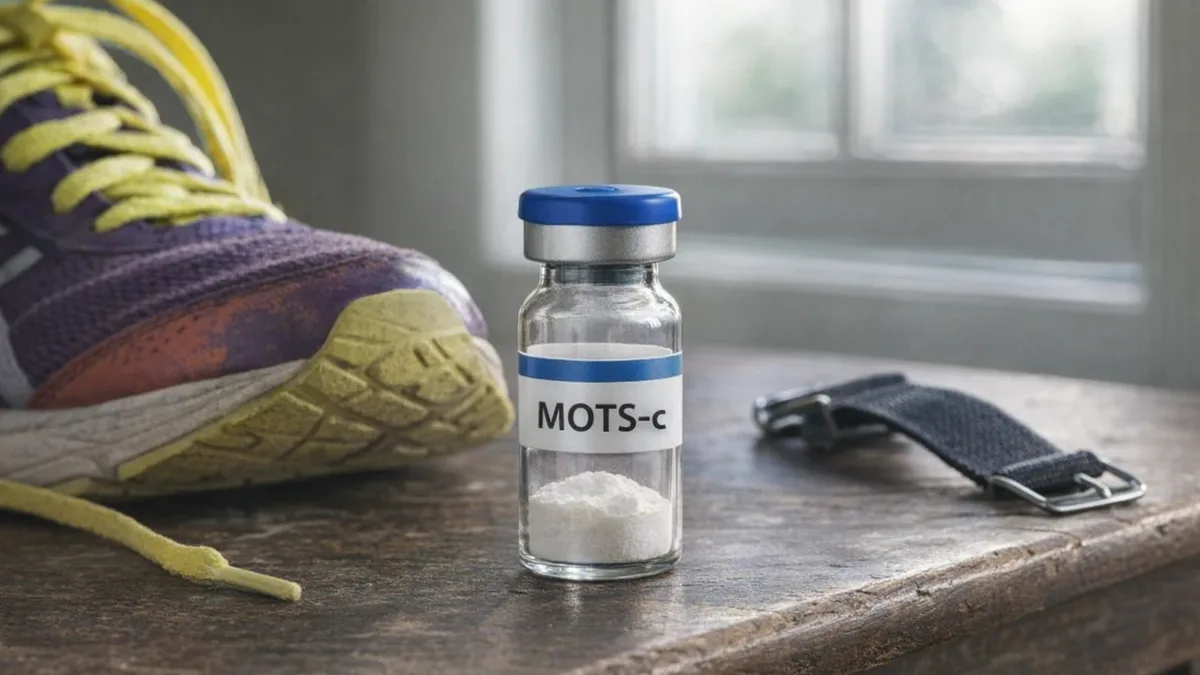
Evidence snapshot
Animal evidence: a 2015 mouse study reported improved insulin sensitivity and resistance to diet-induced obesity.
Human evidence: observational studies report exercise-associated changes in MOTS-c levels.
Clinical gap: no interventional human trial in the reviewed sources established therapeutic benefit.
Regulatory status: MOTS-c is not FDA-approved and was scheduled for FDA advisory committee discussion in July 2026.
Research record
What the evidence record says
- Evidence grade
- Not Graded
- Regulatory status
- MOTS-c regulatory status has not been fully reviewed by Peptide Report editorial team. See company profiles and regulatory watch for current status.
Evidence records
Studies, registries, reviews, and regulatory records
Evidence review pending
- Detailed evidence review for MOTS-c is pending editorial assessment. Current summary reflects available public records.
Records: FDA compounding advisory committee July 2026: peptides, FDA BPC-157 compounding safety risk: immunogenicity, The Mitochondrial-Derived Peptide MOTS-c Promotes Metabolic Homeostasis and Reduces Obesity: Lee et al.
Evidence timeline
What changed, and when
Peptide Report last reviewed MOTS-c on 2026-07-12.
Records: FDA compounding advisory committee July 2026: peptides
Direct answers
Frequently asked questions
What is MOTS-c?
MOTS-c is a mitochondrial peptide tracked by Peptide Report. See the full profile for current editorial assessment.
Open research questions
What is still unknown
- What is the complete human evidence base for MOTS-c?
- What are the long-term safety considerations for MOTS-c?
Tracked claims
MOTS-c is in the July 2026 FDA peptide review queue.
Evidence level: Primary regulatory
Sources: FDA compounding advisory committee July 2026: peptides
How to read this: Committee review does not establish approval or translate preclinical findings into human benefit.
A landmark preclinical study identified MOTS-c as a mitochondrial-derived peptide that improves insulin sensitivity and prevents obesity in mice.
Evidence level: Peer reviewed
How to read this: The Lee et al. 2015 Cell Metabolism study is the key primary source. Results are from mouse models only; no human interventional trials have confirmed therapeutic effects.
Observational human studies report that MOTS-c levels change with exercise, but no interventional trials confirm therapeutic benefits.
Evidence level: Peer reviewed
Sources: MOTS-c in exercise, aging, and metabolic disease: human and preclinical studies
How to read this: Exercise-associated changes in MOTS-c are correlational. Do not present as evidence that MOTS-c supplementation improves metabolic outcomes in humans.
Linked public records
Regulatory actions involving MOTS-c
FDA advisory committee to review seven peptide-related bulk drug substances
Scheduled · Scheduled public meeting
FDA scheduled a two-day Pharmacy Compounding Advisory Committee meeting to discuss whether BPC-157, KPV, TB-500, MOTS-c, emideltide/DSIP, Semax, and Epitalon-related substances should be included on the 503A Bulks List. The committee provides advice; the meeting itself is not a final agency determination.
Compounds: BPC-157, KPV, TB-500, MOTS-c, DSIP, Semax, Epitalon
Free report
Get the source-quality checklist
Use the same checklist Peptide Report uses to separate MOTS-c claims, source records, supplier documentation, and media signals.
V1 collects email, role, and topic interest only. No medication, health-condition, dosing, or current-use data is collected in this form.
Formspree processes this submission for Peptide Report. Privacy notice.
Sources on this page
Each source record is linked to the claim or evidence note it supports.
July 23-24, 2026 Pharmacy Compounding Advisory Committee meeting
FDA Pharmacy Compounding Advisory Committee meeting notice for July 23 to 24, 2026, scheduling peptide bulk substances for discussion.
23 linked pagesOpen original ·
fda-pcac-july-2026Certain bulk drug substances for use in compounding may present significant safety risks
FDA risk page lists BPC-157: compounded BPC-157 may pose immunogenicity risk and peptide-related impurity concerns for certain routes of administration.
41 linked pagesOpen original ·
fda-bulk-risk-listThe Mitochondrial-Derived Peptide MOTS-c Promotes Metabolic Homeostasis and Reduces Obesity: Lee et al.
Lee et al. (2015) landmark study (PMID 25754631) in Cell Metabolism identifying MOTS-c as a mitochondrial-derived peptide that regulates metabolic homeostasis, improves insulin sensitivity, and prevents obesity in mice fed a high-fat diet. Preclinical only.
4 linked pagesOpen original ·
pubmed-motsc-metabolic-lee-2015MOTS-c in exercise, aging, and metabolic disease: human and preclinical studies
Emerging research on MOTS-c in the context of exercise physiology and aging, including observational human studies showing MOTS-c levels change with exercise. No interventional human trials confirming therapeutic effects.
4 linked pagesOpen original ·
pubmed-motsc-exercise-agingRelated compounds
5-Amino-1MQ
5-Amino-1MQ is a small-molecule NNMT inhibitor with published efficacy findings limited to cell and rodent studies. No e...
Regulatory watchAOD-9604
AOD-9604 is a synthetic fragment of human growth hormone developed as a weight-loss candidate. Its Phase 2 obesity progr...
Regulatory watchArgireline (acetyl hexapeptide-8)
Small studies have reported modest wrinkle changes with some Argireline formulations, but results are inconsistent and o...
Evidence reviewBPC-157
BPC-157 is an experimental peptide with extensive animal research but very limited human evidence. A Phase 1 registry re...
Regulatory watchStay informed