Argireline is a trade name for acetyl hexapeptide-8, a cosmetic peptide designed to interfere with proteins involved in neurotransmitter release. That mechanism has been demonstrated in experimental systems, but ordinary topical products are not pharmacologically equivalent to injected botulinum toxin. Human studies are small and inconsistent, and an FDA-affiliated penetration study found no detectable peptide in the dermis after application to human cadaver skin.
Topical cosmetic hexapeptide
Argireline (acetyl hexapeptide-8)
Small studies have reported modest wrinkle changes with some Argireline formulations, but results are inconsistent and ordinary topical formulations show very low penetration beyond the outer skin. It is not equivalent to botulinum toxin.
Evidence review
Last reviewed Jul 12, 2026
Next review Aug 12, 2026
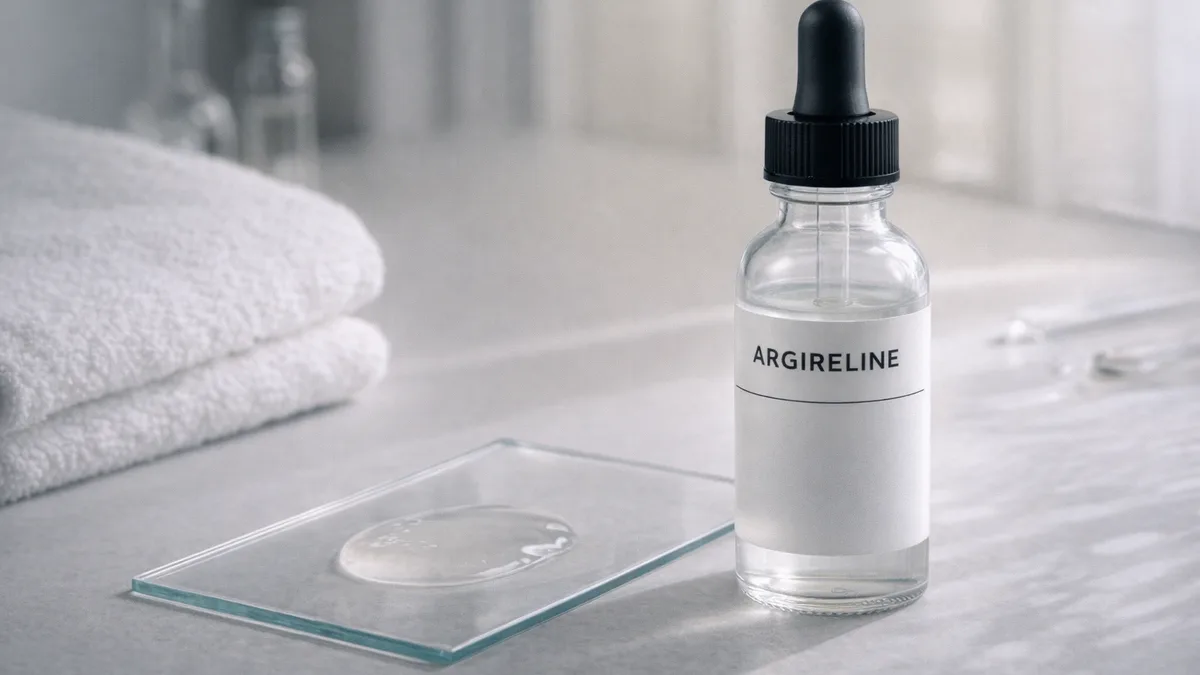
Evidence snapshot
Mechanism: SNAP-25/SNARE interference was reported in experimental systems, with much lower efficacy than botulinum toxin.
Positive human evidence: a 10-person manufacturer-linked study and a 60-person four-week randomized study reported cosmetic improvements.
Negative human evidence: a 19-person double-blind split-face study found no significant Argireline-specific effect.
Delivery: FDA-affiliated researchers detected 0.22% of the applied dose in human stratum corneum, 0.01% in epidermis, and none in dermis or receptor fluid.
Bottom line: limited formulation-specific cosmetic evidence; “Botox in a bottle” is not supported.
Research record
What the evidence record says
- Evidence grade
- Limited human evidence
- Regulatory status
- Used as a cosmetic ingredient. Cosmetics generally do not receive FDA premarket approval; claims to affect skin structure or neuromuscular function may create drug status.
- Also known as
- acetyl hexapeptide-8, AH-8, AHP-8, historically acetyl hexapeptide-3
Evidence records
Studies, registries, reviews, and regulatory records
Original study, 2002
- Ten healthy women used an oil-in-water emulsion containing 10% peptide for 30 days.
- Reported wrinkle-depth reduction “up to 30%.”
- Limitations: only 10 participants, Lipotec-affiliated authors, “up to” is a maximum rather than a group mean, and later methodological analysis noted an unusually permissive p<0.075 threshold.
Records: A synthetic hexapeptide (Argireline) with antiwrinkle activity.
Randomized study, 2013
- Sixty Chinese participants randomized 3:1 to Argireline or placebo, twice daily for four weeks.
- Reported 48.9% “total anti-wrinkle efficacy” by subjective evaluation and improved roughness measures.
- Required wording: the 48.9% figure is a subjective efficacy/responder measure, not a 48.9% reduction in wrinkle depth.
- Limitations: small, short, uneven allocation, limited population, no botulinum-toxin comparison.
Split-face study, 2023
- Nineteen women used a hyaluronic-acid serum with Argireline on one facial side and the same serum without it on the other for four weeks.
- Double-blind; no significant between-side difference in wrinkle score or TruSkin Age.
- Authors concluded efficacy was not proven and it should not be considered an alternative to botulinum toxin.
Microneedle patch
- Fifty-two Korean women enrolled; 50 completed a randomized, double-blind controlled study.
- All groups improved; some outcomes favored acetyl-hexapeptide-8 or EGF patches over patch alone.
- Does not generalize to ordinary serum because the microneedles, cross-linked hyaluronic acid, and hydration are co-interventions.
Penetration evidence
- FDA-affiliated researchers measured 0.22% of the applied dose in human stratum corneum and 0.01% in epidermis.
- No peptide was detected in dermis or receptor fluid under the tested conditions.
- The result applies to the tested formulation and cadaver-skin model; it does not prove that every topical formulation behaves identically.
Records: In vitro skin penetration of acetyl hexapeptide-8 from a cosmetic formulation.
Evidence timeline
What changed, and when
The original manufacturer-linked mechanism and 10-volunteer cosmetic study was published.
Records: A synthetic hexapeptide (Argireline) with antiwrinkle activity.
A 60-person randomized four-week peri-orbital wrinkle study reported positive subjective and roughness results.
FDA-affiliated researchers published human-cadaver-skin penetration findings showing no detectable dermal peptide.
Records: In vitro skin penetration of acetyl hexapeptide-8 from a cosmetic formulation.
A randomized microneedle-patch study reported formulation-specific wrinkle findings.
A small double-blind split-face study found no significant Argireline-specific effect.
Direct answers
Frequently asked questions
What is Argireline?
Argireline is a trade name for acetyl hexapeptide-8, a synthetic cosmetic peptide.
Records: A synthetic hexapeptide (Argireline) with antiwrinkle activity.
Why is it sometimes called acetyl hexapeptide-3?
Older publications and product materials used acetyl hexapeptide-3; acetyl hexapeptide-8 is the common current ingredient name. Readers should verify the exact INCI name on a product label.
Records: A synthetic hexapeptide (Argireline) with antiwrinkle activity.
Is it comparable to Botox?
No. Experimental pathway language overlaps, but botulinum toxin has a different molecule, delivery route, potency, evidence base, and regulatory status.
Records: A synthetic hexapeptide (Argireline) with antiwrinkle activity., Investigating the effects of Argireline in a skin serum containing hyaluronic acids on skin surface wrinkles using the Visia Complexion Analysis camera system for objective skin analysis.
Can it penetrate skin?
An FDA-affiliated study detected very little in the outer skin and none in the dermis or receptor fluid from the tested formulation.
Records: In vitro skin penetration of acetyl hexapeptide-8 from a cosmetic formulation.
What did the 2013 randomized study measure?
It reported a subjective efficacy measure and objective roughness changes after four weeks; it did not show a 48.9% reduction in wrinkle depth.
Does microneedle evidence apply to serums?
No. Microneedles and the patch matrix materially change delivery and are co-interventions.
Does FDA approve cosmetic peptides?
Cosmetic products and ingredients generally do not require FDA premarket approval, except color additives.
Open research questions
What is still unknown
- Adequately powered, independently funded trials using standardized topical formulations.
- Objective dynamic-wrinkle outcomes and durability after stopping.
- Direct comparison with vehicle, retinoids, sunscreen, and approved procedures.
- Whether any ordinary topical formulation reaches a biologically active dermal concentration.
- Long-term sensitization and irritation rates.
- Label-claim stability and peptide content after commercial storage.
Tracked claims
Argireline is Botox in a bottle.
Evidence level: Contradicted by the cited record
Sources: A synthetic hexapeptide (Argireline) with antiwrinkle activity., Investigating the effects of Argireline in a skin serum containing hyaluronic acids on skin surface wrinkles using the Visia Complexion Analysis camera system for objective skin analysis., In vitro skin penetration of acetyl hexapeptide-8 from a cosmetic formulation.
How to read this: The substance, route, potency, tissue exposure, evidence, and regulatory status differ from botulinum toxin.
Argireline reduces wrinkles by 30%.
Evidence level: Overstated
Sources: A synthetic hexapeptide (Argireline) with antiwrinkle activity.
How to read this: The figure is an 'up to' result from a 10-person manufacturer-linked study, not a robust group estimate.
A study showed 48.9% wrinkle reduction.
Evidence level: Misstated
How to read this: The 48.9% was a subjective efficacy measure, not percentage reduction in wrinkle depth.
It relaxes facial muscles like botulinum toxin.
Evidence level: Topical mechanism remains uncertain
Sources: A synthetic hexapeptide (Argireline) with antiwrinkle activity., In vitro skin penetration of acetyl hexapeptide-8 from a cosmetic formulation.
How to read this: In-vitro SNARE findings exist, but human cadaver skin showed no detectable dermal penetration.
Clinical studies consistently prove it works.
Evidence level: Contradicted by the cited record
Sources: The anti-wrinkle efficacy of argireline, a synthetic hexapeptide, in Chinese subjects: a randomized, placebo-controlled study, Investigating the effects of Argireline in a skin serum containing hyaluronic acids on skin surface wrinkles using the Visia Complexion Analysis camera system for objective skin analysis.
How to read this: Small trials are inconsistent; a 2023 double-blind split-face study was negative.
Any product containing Argireline should work.
Evidence level: Contradicted by the cited record
Sources: In vitro skin penetration of acetyl hexapeptide-8 from a cosmetic formulation., Topical delivery of acetyl hexapeptide-8 from different emulsions: influence of emulsion composition and internal structure.
How to read this: Concentration, vehicle, stability, and delivery determine exposure.
Argireline is FDA-approved.
Evidence level: Misleading framing
Sources: Wrinkle Treatments and Other Anti-aging Products.
How to read this: Cosmetics generally do not undergo FDA premarket approval.
Argireline is safe to inject.
Evidence level: Unsupported by the cited record
Sources: Mycobacterium abscessus infection after facial injection of argireline: A case report.
How to read this: Human cosmetic evidence does not validate injection; a published case described infection after facial injection.
Free report
Get the source-quality checklist
Use the same checklist Peptide Report uses to separate Argireline (acetyl hexapeptide-8) claims, source records, supplier documentation, and media signals.
V1 collects email, role, and topic interest only. No medication, health-condition, dosing, or current-use data is collected in this form.
Formspree processes this submission for Peptide Report. Privacy notice.
Sources on this page
Each source record is linked to the claim or evidence note it supports.
A synthetic hexapeptide (Argireline) with antiwrinkle activity.
Blanes-Mira C, Clemente J, Jodas G, et al. A synthetic hexapeptide (Argireline) with antiwrinkle activity. Int J Cosmet Sci. 2002;24(5):303-310. doi:10.1046/j.1467-2494.2002.00153.x. PMID 18498523.
1 linked pageOpen original ·
research-arg-01The anti-wrinkle efficacy of argireline, a synthetic hexapeptide, in Chinese subjects: a randomized, placebo-controlled study
Randomized, placebo-controlled four-week study of topical acetyl hexapeptide-8 in 60 Chinese participants. The small, short study reported subjective and skin-roughness outcomes and did not compare the product with botulinum toxin.
4 linked pagesOpen original ·
pubmed-argireline-clinical-2013Investigating the effects of Argireline in a skin serum containing hyaluronic acids on skin surface wrinkles using the Visia Complexion Analysis camera system for objective skin analysis.
Henseler H. Investigating the effects of Argireline in a skin serum containing hyaluronic acids on skin surface wrinkles using the Visia Complexion Analysis camera system for objective skin analysis. GMS Interdiscip Plast Reconstr Surg DGPW. 2023;12:Doc09. doi:10.3205/iprs000179. PMID 38024099; PMCID PMC10665711.
1 linked pageOpen original ·
research-arg-03In vitro skin penetration of acetyl hexapeptide-8 from a cosmetic formulation.
Kraeling MEK, Zhou W, Wang P, Ogunsola OA. In vitro skin penetration of acetyl hexapeptide-8 from a cosmetic formulation. Cutan Ocul Toxicol. 2015;34(1):46-52. doi:10.3109/15569527.2014.894521. PMID 24754410.
1 linked pageOpen original ·
research-arg-05Anti-Wrinkle Efficacy of Cross-Linked Hyaluronic Acid-Based Microneedle Patch with Acetyl Hexapeptide-8 and Epidermal Growth Factor on Korean Skin.
An JH, Lee HJ, Yoon MS, Kim DH. Anti-Wrinkle Efficacy of Cross-Linked Hyaluronic Acid-Based Microneedle Patch with Acetyl Hexapeptide-8 and Epidermal Growth Factor on Korean Skin. Ann Dermatol. 2019;31(3):263-271. doi:10.5021/ad.2019.31.3.263. PMID 33911590; PMCID PMC7992733.
1 linked pageOpen original ·
research-arg-04Topical delivery of acetyl hexapeptide-8 from different emulsions: influence of emulsion composition and internal structure.
Hoppel M, Reznicek G, Kahlig H, et al. Topical delivery of acetyl hexapeptide-8 from different emulsions: influence of emulsion composition and internal structure. Eur J Pharm Sci. 2015;68:27-35. doi:10.1016/j.ejps.2014.12.006. PMID 25497319.
1 linked pageOpen original ·
research-arg-06Wrinkle Treatments and Other Anti-aging Products.
U.S. Food and Drug Administration. Wrinkle Treatments and Other Anti-aging Products. Accessed 2026-07-12.
1 linked pageOpen original ·
research-arg-07Mycobacterium abscessus infection after facial injection of argireline: A case report.
Mycobacterium abscessus infection after facial injection of argireline: A case report. 2021. PMCID PMC7953399.
1 linked pageOpen original ·
research-arg-08Related compounds
Matrixyl (Palmitoyl Pentapeptide-4)
Matrixyl, or palmitoyl pentapeptide-4, is a cosmetic peptide used in anti-wrinkle skincare. Small controlled studies rep...
Evidence review5-Amino-1MQ
5-Amino-1MQ is a small-molecule NNMT inhibitor with published efficacy findings limited to cell and rodent studies. No e...
Regulatory watchAOD-9604
AOD-9604 is a synthetic fragment of human growth hormone developed as a weight-loss candidate. Its Phase 2 obesity progr...
Regulatory watchBPC-157
BPC-157 is an experimental peptide with extensive animal research but very limited human evidence. A Phase 1 registry re...
Regulatory watchStay informed