The human record is empty. No exact-name ClinicalTrials.gov record was located at the August 1, 2026 research cutoff. Published efficacy findings come from cell and rodent studies. Diet-induced-obese mice showed changes in body weight, fat mass, glucose handling, and liver pathology, while aged female mice showed improved grip strength. A rat pharmacokinetic study reported approximately 38.4% oral bioavailability. These findings have not been demonstrated in people. FDA has also stated that 5-Amino-1MQ does not qualify for 503B compounding exemptions.
Small-molecule methylquinolinium inhibitor of nicotinamide N-methyltransferase (NNMT); not a peptide
5-Amino-1MQ
5-Amino-1MQ is a small-molecule NNMT inhibitor with published efficacy findings limited to cell and rodent studies. No exact-name ClinicalTrials.gov record was located at the August 1, 2026 research cutoff, and this review did not establish human benefits, safety, pharmacokinetics, or a clinical formulation. FDA has specifically identified 5-Amino-1MQ as ineligible for 503B bulk-compounding exemptions.
Regulatory watch
Last reviewed Aug 1, 2026
Next review Sep 1, 2026
Evidence snapshot
Human trial record: no exact-name ClinicalTrials.gov record was located at the August 1, 2026 research cutoff. This is a dated registry search result, not permanent proof that no study exists.
Animal obesity study: a short diet-induced-obesity mouse study reported approximately 5.1% weight loss versus 1.4% weight gain in controls over 11 days, with no significant food-intake difference.
Animal metabolic study: a 28-day diet-induced-obesity mouse study reported dose-dependent limitation of weight and fat-mass gain, improved glucose tolerance and insulin sensitivity, and reduced hepatic steatosis.
Animal muscle study: aged female mice treated for eight weeks showed approximately 40% greater grip strength than sedentary controls.
Pharmacokinetics: a rat LC-MS/MS study reported approximately 38.4% oral bioavailability; this does not validate commercial human capsules.
Regulatory status: FDA specifically identified 5-Amino-1MQ as ineligible for 503B bulk-compounding exemptions in a January 20, 2026 warning letter.
Mechanism: in cultured adipocytes, 5-Amino-1MQ reduced 1-methylnicotinamide and altered NAD+ and S-adenosylmethionine levels; cellular changes do not establish human clinical benefit.
Context map
Three evidence layers that answer different questions
A rodent obesity model, a supplier vial listing, and a weight-loss anecdote are not interchangeable. Each layer below has its own source type and limit.
-
Studied context
Cell and rodent studies with no human trials
The controlled record consists of in-vitro adipocyte experiments and short-term mouse studies. No registered or published human trials were located.
- A 2018 foundational study in diet-induced-obese male C57BL/6 mice (n=9 per cohort) treated subcutaneously for 11 days reported approximately 5.1% weight loss versus 1.4% weight gain in controls, with no significant food-intake difference.
- A 2024 study in diet-induced-obese mice treated once daily for 28 days reported dose-dependent limitation of weight and fat-mass gain, improved glucose tolerance and insulin sensitivity, and reduced hepatic steatosis.
- A 2024 study in aged female mice treated for eight weeks reported approximately 40% greater grip strength than sedentary controls.
- A 2021 rat LC-MS/MS study reported approximately 38.4% oral bioavailability.
- In cultured adipocytes, 5-Amino-1MQ reduced 1-methylnicotinamide and altered NAD+ and S-adenosylmethionine levels.
Study records: Selective and membrane-permeable small molecule inhibitors of nicotinamide N-methyltransferase reverse high fat diet-induced obesity in mice., Nicotinamide N-methyltransferase inhibition mitigates obesity-related metabolic dysfunction., Development & validation of LC-MS/MS assay for 5-amino-1-methyl quinolinium in rat plasma: Application to pharmacokinetic and oral bioavailability studies., Nicotinamide N-methyltransferase inhibition mimics and boosts exercise-mediated improvements in muscle function in aged mice.
Evidence boundary: These records do not test the vial, capsule, and tablet formats observed in the research-use market, and the preclinical findings do not establish human efficacy for any indication.
-
Observed market presentation
Research-use vials from RUO suppliers
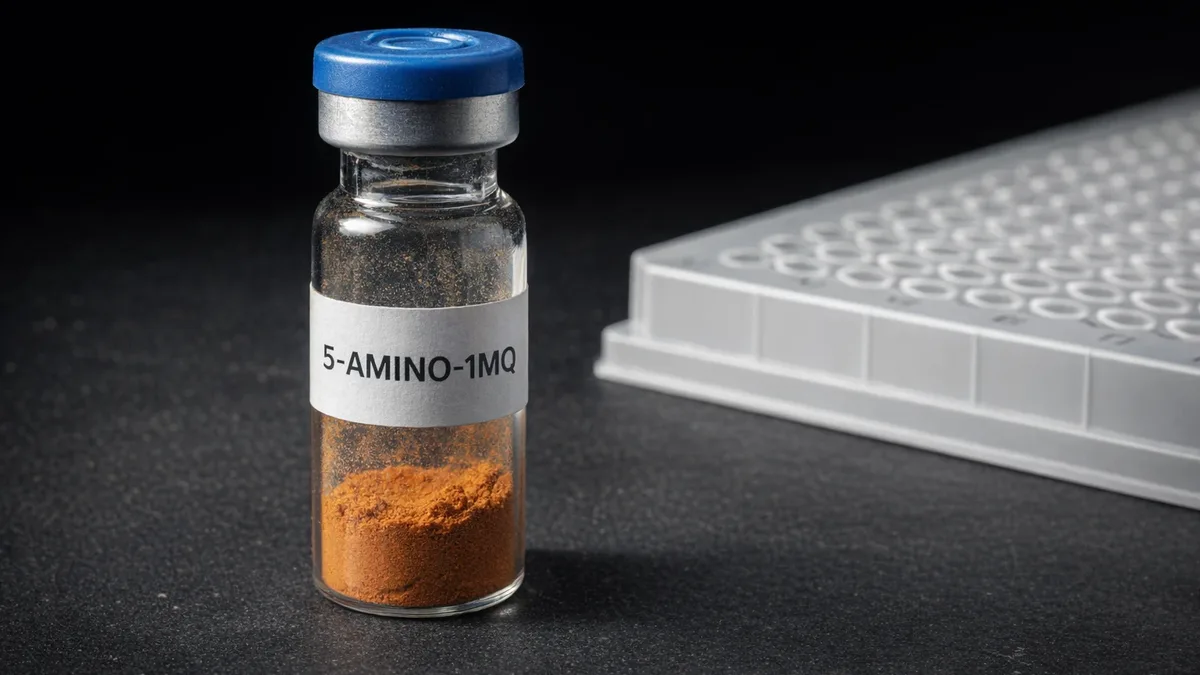
5-Amino-1MQ appears in research-use-only supplier catalogs as lyophilized powder vials. The compound is a small-molecule methylquinolinium NNMT inhibitor sold alongside peptide products.
- RUO suppliers list 5-Amino-1MQ in 25 mg vial format.
- The compound is marketed for laboratory research use only.
- FDA has identified 5-Amino-1MQ as ineligible for 503B bulk compounding.
- Product listings
- 1
- Testing records
- 1
- Observed formats
- Single-compound vials
- Supplier-issued document1
Inspect the linked testing records
Evidence boundary: Catalog records are market observations only. They are not evidence of identity, purity, safety, or efficacy.
-
Anecdotal and media signal
Growing search interest in human trials and clinical evidence
Search data shows growing interest in 5-Amino-1MQ human trials and clinical evidence, with 29 query variants generating 66 impressions in 28 days. The compound is frequently discussed in peptide and biohacking communities despite having no human trial data.
- 29 query variants related to 5-Amino-1MQ human trials and clinical evidence tracked in Search Console.
- Community interest centers on fat loss and metabolic effects from rodent studies.
- No human clinical trial results have been published.
1 claim tracked across 1 video review
Educational review of NNMT inhibitor mechanism and preclinical evidenceEvidence boundary: Community and search interest are discovery signals only. They do not establish safety, efficacy, or appropriate use.
Research record
What the evidence record says
- Evidence grade
- Preclinical evidence only
- Regulatory status
- 5-Amino-1MQ is not an FDA-approved drug and has no approved formulation. FDA's January 20, 2026 warning letter to GenoGenix LLC specifically identified 5-Amino-1MQ as ineligible for 503B bulk-compounding exemptions because it does not appear on the 503B bulks list and is not used to compound a drug on the shortage list. No exact-name ClinicalTrials.gov record was located at the August 1, 2026 research cutoff.
- Also known as
- 5-amino-1-methylquinolinium, 5A1MQ, 5-AMQ, 5-amino-1-methylquinolinium iodide
Evidence records
Studies, registries, reviews, and regulatory records
Foundational obesity pharmacology
- Male diet-induced-obese C57BL/6 mice, nine per cohort, treated subcutaneously for 11 days.
- Treated mice lost about 5.1% of baseline weight while controls gained about 1.4%.
- White-adipose mass, adipocyte size, and plasma total cholesterol decreased; cumulative food intake was not significantly different.
- In vitro, 5-Amino-1MQ reduced 1-methylnicotinamide and altered NAD+ and S-adenosylmethionine in adipocytes.
- Limitations: nine animals per group, one sex, one model, 11 days, repeated injections, no human translation.
2024 metabolic and liver study
- Diet-induced-obese mice received vehicle or 5A1MQ daily for 28 days.
- Reported dose-dependent limitation of weight and fat-mass gain, improved glucose tolerance and insulin sensitivity, reduced hyperinsulinemia, and improvements in steatosis and liver markers.
- Subcutaneous exposure reached adipose, muscle, and liver.
- Investigators had Ridgeline Therapeutics affiliations; commercial interests should be disclosed.
Records: Nicotinamide N-methyltransferase inhibition mitigates obesity-related metabolic dysfunction.
Rat pharmacokinetics
- Reported oral bioavailability of approximately 38.4% in rats.
- Mean terminal elimination half-life of 3.80 hours after intravenous and 6.90 hours after oral administration.
- This is an assay and animal-PK result, not evidence of efficacy, safety, stability, or absorption for a human commercial product.
Aged muscle study
- Thirty-five aged female mice divided among sedentary/exercise and vehicle/5-A1MQ groups for eight weeks.
- Treated sedentary mice showed roughly 40% greater grip strength than sedentary controls.
- Does not establish muscle gain, sarcopenia treatment, or rejuvenation in humans.
- Investigators disclosed Ridgeline Therapeutics affiliations and commercial interests.
Regulatory status
- FDA's January 20, 2026 warning letter to GenoGenix LLC identified 5-Amino-1MQ as ineligible for 503B compounding exemptions.
- 5-Amino-1MQ does not appear on the 503B bulks list and is not used to compound a drug on the shortage list.
- No FDA-approved indication exists for any route or formulation.
Records: GenoGenix LLC Warning Letter 718739.
Evidence timeline
What changed, and when
The foundational direct 5-Amino-1MQ paper reported NNMT inhibition in adipocytes and metabolic effects in diet-induced-obese mice.
A rat LC-MS/MS and pharmacokinetic study reported approximately 38.4% oral bioavailability.
A mouse study examined 5A-1MQ combined with a reduced-calorie diet and microbiome changes.
Records: Reduced calorie diet combined with NNMT inhibition establishes a distinct microbiome in DIO mice.
A 28-day diet-induced-obesity mouse study reported metabolic and liver findings.
Records: Nicotinamide N-methyltransferase inhibition mitigates obesity-related metabolic dysfunction.
An aged-female-mouse study reported muscle-function findings.
FDA issued a warning letter identifying 5-Amino-1MQ as ineligible for 503B compounding exemptions.
Records: GenoGenix LLC Warning Letter 718739.
Direct answers
Frequently asked questions
Is 5-Amino-1MQ a peptide?
No. It is a small-molecule inhibitor of NNMT, a cytosolic enzyme involved in cellular metabolism.
Has it been studied in humans?
No exact-name ClinicalTrials.gov record was located as of August 1, 2026. That dated search does not prove that no study exists in every registry or publication database.
Records: ClinicalTrials.gov exact-name search, accessed 2026-07-12
What did the original mouse study find?
A short study in obese male mice reported reduced body weight and fat measures without a significant food-intake difference.
Does it increase NAD+?
It altered NAD+ in cultured adipocytes, but a beneficial NAD+ effect has not been established in humans.
Is oral use proven?
No. Rat pharmacokinetic data do not establish human absorption, safety, or efficacy.
Is it eligible for 503B compounding?
FDA stated that it is absent from the 503B bulks list and not used to compound a drug on the shortage list.
Records: GenoGenix LLC Warning Letter 718739.
Open research questions
What is still unknown
- First-in-human pharmacokinetics, metabolism, target engagement, and elimination.
- Acute and chronic cardiovascular, neurologic, hepatic, renal, reproductive, and genotoxic safety.
- Whether chronic NNMT inhibition produces tissue-specific harms.
- Whether metabolic effects occur in humans independently of dietary change.
- Identity, purity, stability, and formulation standards for online products.
- Context-dependent cancer effects of chronic NNMT inhibition.
Tracked claims
5-Amino-1MQ is a peptide.
Evidence level: Contradicted by the cited record
How to read this: It is a methylquinolinium small molecule, not a peptide.
It burns fat in humans.
Evidence level: Unsupported by the cited record
Sources: Selective and membrane-permeable small molecule inhibitors of nicotinamide N-methyltransferase reverse high fat diet-induced obesity in mice., Nicotinamide N-methyltransferase inhibition mitigates obesity-related metabolic dysfunction., ClinicalTrials.gov exact-name search, accessed 2026-07-12
How to read this: Direct efficacy findings come from obese mice, not human trials. No exact-name ClinicalTrials.gov record was located.
It causes weight loss without reducing appetite.
Evidence level: Preclinical evidence only
How to read this: Food intake was unchanged in a short mouse study; this has not been shown in people.
It boosts NAD+ and mitochondrial function in people.
Evidence level: Mechanism exceeds clinical evidence
How to read this: Cellular NAD+ changes in cultured adipocytes do not establish a human clinical benefit.
It improves insulin sensitivity or fatty liver.
Evidence level: Preclinical evidence only
Sources: Nicotinamide N-methyltransferase inhibition mitigates obesity-related metabolic dysfunction.
How to read this: These outcomes were reported in diet-induced-obese mice. Investigators had Ridgeline Therapeutics affiliations.
It reverses sarcopenia.
Evidence level: Preclinical evidence only
How to read this: Muscle findings come from aged female mice. Investigators disclosed Ridgeline Therapeutics affiliations.
Oral 5-Amino-1MQ is clinically validated.
Evidence level: Contradicted by the cited record
Sources: Development & validation of LC-MS/MS assay for 5-amino-1-methyl quinolinium in rat plasma: Application to pharmacokinetic and oral bioavailability studies., ClinicalTrials.gov exact-name search, accessed 2026-07-12
How to read this: Rat bioavailability does not validate a human formulation. No human pharmacokinetic or efficacy data exist.
It has no known side effects.
Evidence level: Misleading framing
Sources: ClinicalTrials.gov exact-name search, accessed 2026-07-12
How to read this: The absence of human trials means human adverse effects are largely unknown.
A compounded version is FDA-approved.
Evidence level: Contradicted by the cited record
Sources: GenoGenix LLC Warning Letter 718739.
How to read this: FDA specifically identified 5-Amino-1MQ as ineligible for 503B compounding exemptions.
Free report
Get the source-quality checklist
Use the same checklist Peptide Report uses to separate 5-Amino-1MQ claims, source records, supplier documentation, and media signals.
V1 collects email, role, and topic interest only. No medication, health-condition, dosing, or current-use data is collected in this form.
Formspree processes this submission for Peptide Report. Privacy notice.
Sources on this page
Each source record is linked to the claim or evidence note it supports.
ClinicalTrials.gov exact-name search, accessed 2026-07-12
ClinicalTrials.gov exact-name search, accessed 2026-07-12. No exact-name human trial located.
2 linked pagesOpen original ·
research-amq-06Selective and membrane-permeable small molecule inhibitors of nicotinamide N-methyltransferase reverse high fat diet-induced obesity in mice.
Neelakantan H, Vance V, Wetzel MD, Wang HL, McHardy SF, Finnerty CC, Hommel JD, Watowich SJ. Selective and membrane-permeable small molecule inhibitors of nicotinamide N-methyltransferase reverse high fat diet-induced obesity in mice. Biochem Pharmacol. 2018;147:141-152. doi:10.1016/j.bcp.2017.11.007. PMID 29155147; PMCID PMC5826726.
2 linked pagesOpen original ·
research-amq-01Nicotinamide N-methyltransferase inhibition mitigates obesity-related metabolic dysfunction.
Babula JAJ, Bui D, Stevenson HL, Watowich SJ, Neelakantan H. Nicotinamide N-methyltransferase inhibition mitigates obesity-related metabolic dysfunction. Diabetes Obes Metab. 2024;26(11):5272-5282. doi:10.1111/dom.15879. PMID 39161060.
2 linked pagesOpen original ·
research-amq-02Nicotinamide N-methyltransferase inhibition mimics and boosts exercise-mediated improvements in muscle function in aged mice.
Dimet-Wiley AL, Latham CM, Brightwell CR, et al. Nicotinamide N-methyltransferase inhibition mimics and boosts exercise-mediated improvements in muscle function in aged mice. Sci Rep. 2024;14:15554. doi:10.1038/s41598-024-66034-9. PMID 38969654; PMCID PMC11226645.
1 linked pageOpen original ·
research-amq-04Development & validation of LC-MS/MS assay for 5-amino-1-methyl quinolinium in rat plasma: Application to pharmacokinetic and oral bioavailability studies.
Awosemo O, Neelakantan H, Watowich S, Ma J, Wu L, Chow DS, Liang D. Development & validation of LC-MS/MS assay for 5-amino-1-methyl quinolinium in rat plasma: Application to pharmacokinetic and oral bioavailability studies. J Pharm Biomed Anal. 2021;204:114255. doi:10.1016/j.jpba.2021.114255. PMID 34304009.
1 linked pageOpen original ·
research-amq-03GenoGenix LLC Warning Letter 718739.
U.S. Food and Drug Administration. GenoGenix LLC Warning Letter 718739. Issued 2026-01-20; content current 2026-03-03.
1 linked pageOpen original ·
research-amq-05Reduced calorie diet combined with NNMT inhibition establishes a distinct microbiome in DIO mice.
Dimet-Wiley AL, et al. Reduced calorie diet combined with NNMT inhibition establishes a distinct microbiome in DIO mice. Sci Rep. 2022;12:484. doi:10.1038/s41598-021-03670-5.
2 linked pagesOpen original ·
research-amq-07Related compounds
AOD-9604
AOD-9604 is a synthetic fragment of human growth hormone developed as a weight-loss candidate. Its Phase 2 obesity progr...
Regulatory watchArgireline (acetyl hexapeptide-8)
Small studies have reported modest wrinkle changes with some Argireline formulations, but results are inconsistent and o...
Evidence reviewBPC-157
BPC-157 is an experimental peptide with extensive animal research but very limited human evidence. A Phase 1 registry re...
Regulatory watchCerebrolysin
Cerebrolysin is a porcine brain-derived peptide preparation used for neurological indications in several countries. It i...
Regulatory watchStay informed