Matrixyl, or palmitoyl pentapeptide-4, is a cosmetic peptide used in anti-wrinkle skincare. Small controlled studies report modest changes in fine lines and wrinkles with specific formulations. It is a cosmetic ingredient, not an FDA-approved drug.
Cosmetic peptide
Matrixyl (Palmitoyl Pentapeptide-4)
Matrixyl, or palmitoyl pentapeptide-4, is a cosmetic peptide used in anti-wrinkle skincare. Small controlled studies report modest changes in fine lines and wrinkles with specific formulations. It is a cosmetic ingredient, not an FDA-approved drug.
Evidence review
Last reviewed Jul 1, 2026
Next review Jul 29, 2026
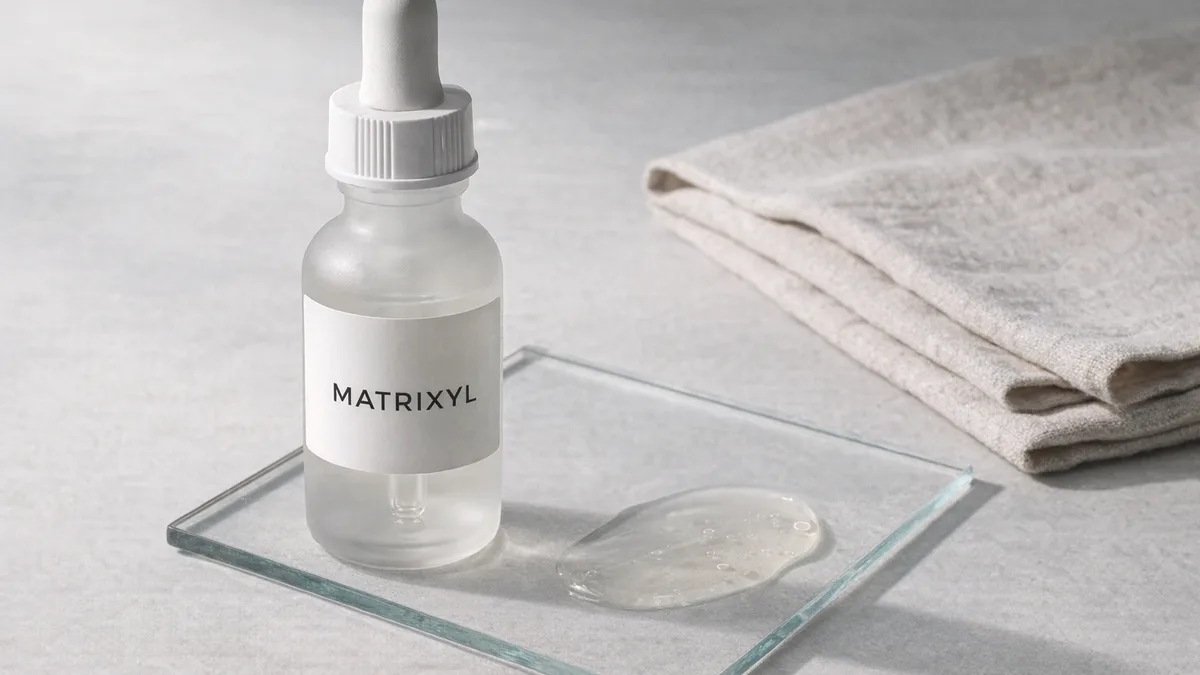
Evidence snapshot
A 12-week double-blind, placebo-controlled, split-face randomized clinical study (n=93, Caucasian females aged 35-55) showed that topical 3 ppm pal-KTTKS provided significant improvement in fine lines and wrinkles vs. placebo, measured by both quantitative technical analysis and expert grader image analysis (Robinson et al., Int J Cosmet Sci, 2005).
In vitro studies demonstrate palmitoyl pentapeptide-4 activates neosynthesis of extracellular matrix macromolecules including collagen, providing a mechanistic basis for its anti-wrinkle effect.
A 2014 study characterized the dermal stability and in vitro skin permeation of KTTKS and palmitoyl-KTTKS, confirming the palmitoyl chain improves peptide penetration through skin lipid structures (Biomol Ther, 2014).
Matrixyl is classified as a cosmetic ingredient (OTC) with no FDA drug approval. It is widely marketed in skincare products with collagen stimulation claims.
Research record
What the evidence record says
- Evidence grade
- Not Graded
- Regulatory status
- Matrixyl (Palmitoyl Pentapeptide-4) regulatory status has not been fully reviewed by Peptide Report editorial team. See company profiles and regulatory watch for current status.
Evidence records
Studies, registries, reviews, and regulatory records
Evidence review pending
- Detailed evidence review for Matrixyl (Palmitoyl Pentapeptide-4) is pending editorial assessment. Current summary reflects available public records.
Records: Topical palmitoyl pentapeptide provides improvement in photoaged human facial skin, Dermal Stability and In Vitro Skin Permeation of Collagen Pentapeptides (KTTKS and palmitoyl-KTTKS), Development of a LC-MS/MS method to monitor palmitoyl peptides content in anti-wrinkle cosmetics
Evidence timeline
What changed, and when
Peptide Report last reviewed Matrixyl (Palmitoyl Pentapeptide-4) on 2026-07-01.
Records: Topical palmitoyl pentapeptide provides improvement in photoaged human facial skin
Direct answers
Frequently asked questions
What is Matrixyl (Palmitoyl Pentapeptide-4)?
Matrixyl (Palmitoyl Pentapeptide-4) is a cosmetic peptide tracked by Peptide Report. See the full profile for current editorial assessment.
Open research questions
What is still unknown
- What is the complete human evidence base for Matrixyl (Palmitoyl Pentapeptide-4)?
- What are the long-term safety considerations for Matrixyl (Palmitoyl Pentapeptide-4)?
Tracked claims
Matrixyl stimulates collagen production and reduces wrinkles.
Evidence level: Peer reviewed
Sources: Topical palmitoyl pentapeptide provides improvement in photoaged human facial skin, Dermal Stability and In Vitro Skin Permeation of Collagen Pentapeptides (KTTKS and palmitoyl-KTTKS)
How to read this: Cite the Robinson et al. 2005 clinical study directly. The evidence supports modest improvement in fine lines/wrinkles in a controlled trial. Do not overstate as equivalent to prescription retinoids or procedures.
Matrixyl is widely available in over-the-counter skincare products.
Evidence level: Market observation
Sources: Palmitoyl pentapeptide-4 - Wikipedia, Development of a LC-MS/MS method to monitor palmitoyl peptides content in anti-wrinkle cosmetics
How to read this: Track market availability without endorsing specific products. Matrixyl is a cosmetic ingredient, not an FDA-approved drug. Do not publish sourcing or purchasing guidance.
The palmitoyl chain improves skin penetration of the peptide.
Evidence level: Peer reviewed
Sources: Dermal Stability and In Vitro Skin Permeation of Collagen Pentapeptides (KTTKS and palmitoyl-KTTKS), Palmitoyl pentapeptide-4 - Wikipedia
How to read this: Supported by in vitro permeation studies. This is mechanistic evidence, not clinical efficacy proof.
Free report
Get the source-quality checklist
Use the same checklist Peptide Report uses to separate Matrixyl (Palmitoyl Pentapeptide-4) claims, source records, supplier documentation, and media signals.
V1 collects email, role, and topic interest only. No medication, health-condition, dosing, or current-use data is collected in this form.
Formspree processes this submission for Peptide Report. Privacy notice.
Sources on this page
Each source record is linked to the claim or evidence note it supports.
Topical palmitoyl pentapeptide provides improvement in photoaged human facial skin
Topical palmitoyl pentapeptide provides improvement in photoaged human facial skin
4 linked pagesOpen original ·
pubmed-palmitoyl-pentapeptide-clinical-2005Dermal Stability and In Vitro Skin Permeation of Collagen Pentapeptides (KTTKS and palmitoyl-KTTKS)
Dermal Stability and In Vitro Skin Permeation of Collagen Pentapeptides (KTTKS and palmitoyl-KTTKS)
4 linked pagesOpen original ·
pubmed-kttks-permeation-2014Development of a LC-MS/MS method to monitor palmitoyl peptides content in anti-wrinkle cosmetics
Development of a LC-MS/MS method to monitor palmitoyl peptides content in anti-wrinkle cosmetics
2 linked pagesOpen original ·
pubmed-palmitoyl-pentapeptide-cosmetics-2009Palmitoyl pentapeptide-4 - Wikipedia
Palmitoyl pentapeptide-4 - Wikipedia
2 linked pagesOpen original ·
wikipedia-matrixylRelated compounds
Argireline (acetyl hexapeptide-8)
Small studies have reported modest wrinkle changes with some Argireline formulations, but results are inconsistent and o...
Evidence review5-Amino-1MQ
5-Amino-1MQ is a small-molecule NNMT inhibitor with published efficacy findings limited to cell and rodent studies. No e...
Regulatory watchAOD-9604
AOD-9604 is a synthetic fragment of human growth hormone developed as a weight-loss candidate. Its Phase 2 obesity progr...
Regulatory watchBPC-157
BPC-157 is an experimental peptide with extensive animal research but very limited human evidence. A Phase 1 registry re...
Regulatory watchStay informed