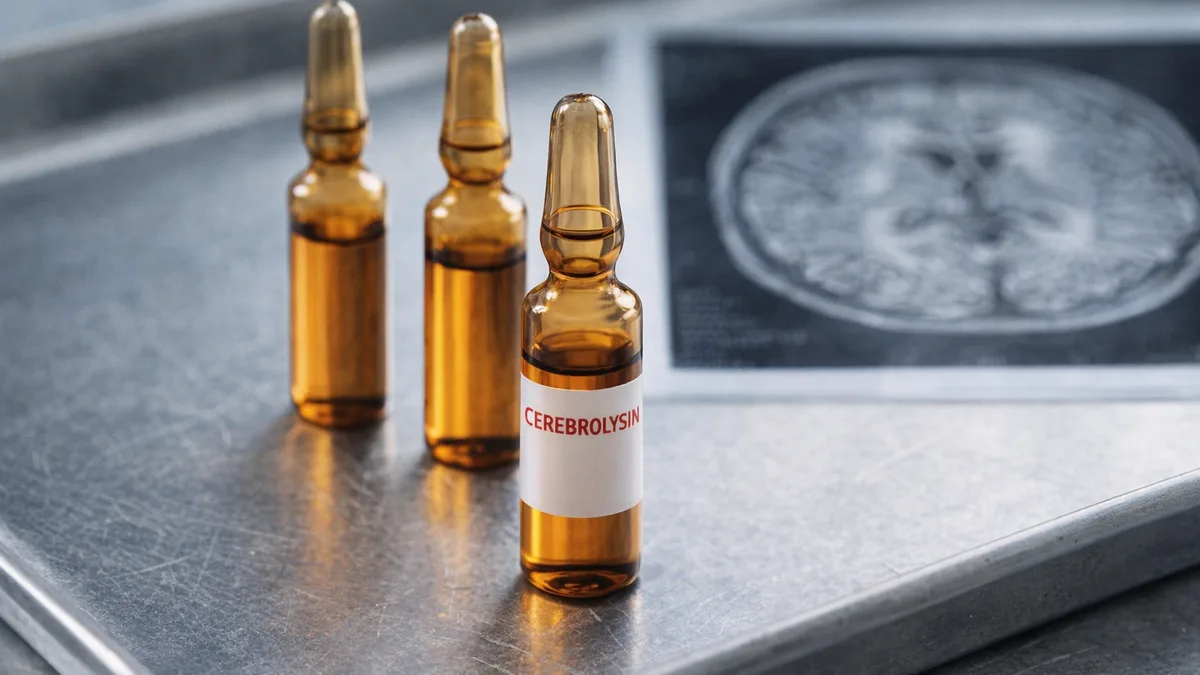
Cerebrolysin is a porcine brain-derived peptide preparation used for neurological indications in several countries. It is not FDA-approved in the United States. Clinical studies and systematic reviews report mixed findings, with continued calls for larger and higher-quality trials.
Peptide preparation
Cerebrolysin
Cerebrolysin is a porcine brain-derived peptide preparation used for neurological indications in several countries. It is not FDA-approved in the United States. Clinical studies and systematic reviews report mixed findings, with continued calls for larger and higher-quality trials.
Regulatory watch
Last reviewed Jul 1, 2026
Next review Jul 29, 2026
Evidence snapshot
A Cochrane systematic review examined Cerebrolysin for vascular dementia, finding it is used as daily intravenous infusions in many countries but concluding results were inconsistent and higher-quality trials are needed (Cui et al., Cochrane Database Syst Rev, 2019; CD008900).
A 2025 prospective, randomized, open-label, blinded-endpoint pilot trial (CLINCH) evaluated Cerebrolysin for intracerebral hemorrhage, finding it was safe and feasible to study (Kobayashi et al., Front Neurol, 2025).
A 2026 systematic review and meta-analysis found Cerebrolysin as an adjunct to mechanical thrombectomy in acute ischemic stroke showed promise but required further study (Brain Behav, 2026).
Cerebrolysin is not approved by the FDA for any indication. It is manufactured by Ever Pharma (Unterach, Austria) and is available in over 40 countries, primarily in Europe and Asia.
Research record
What the evidence record says
- Evidence grade
- Not Graded
- Regulatory status
- Cerebrolysin regulatory status has not been fully reviewed by Peptide Report editorial team. See company profiles and regulatory watch for current status.
Evidence records
Studies, registries, reviews, and regulatory records
Evidence review pending
- Detailed evidence review for Cerebrolysin is pending editorial assessment. Current summary reflects available public records.
Records: Cerebrolysin for vascular dementia, Safety and feasibility of cerebrolysin in treatment of primary intracerebral hemorrhage (CLINCH)-a prospective, randomized, open-label, blinded endpoint pilot trial, Efficacy and Safety of Cerebrolysin as an Adjunct to Mechanical Thrombectomy in Acute Ischemic Stroke: A Systematic Review and Meta-Analysis
Evidence timeline
What changed, and when
Peptide Report last reviewed Cerebrolysin on 2026-07-01.
Records: Cerebrolysin for vascular dementia
Direct answers
Frequently asked questions
What is Cerebrolysin?
Cerebrolysin is a peptide preparation tracked by Peptide Report. See the full profile for current editorial assessment.
Open research questions
What is still unknown
- What is the complete human evidence base for Cerebrolysin?
- What are the long-term safety considerations for Cerebrolysin?
Tracked claims
Cerebrolysin is approved in 40+ countries but not FDA-approved for use in the United States.
Evidence level: Primary regulatory
Sources: Cerebrolysin for vascular dementia, Cerebrolysin - Wikipedia
How to read this: Confirm regulatory status on each review cycle. The compound cannot be legally prescribed or sold in the United States. Update immediately if FDA status changes.
Clinical trials, including Cochrane reviews, have examined Cerebrolysin for vascular dementia and stroke recovery.
Evidence level: Peer reviewed
Sources: Cerebrolysin for vascular dementia, Safety and feasibility of cerebrolysin in treatment of primary intracerebral hemorrhage (CLINCH)-a prospective, randomized, open-label, blinded endpoint pilot trial, Efficacy and Safety of Cerebrolysin as an Adjunct to Mechanical Thrombectomy in Acute Ischemic Stroke: A Systematic Review and Meta-Analysis
How to read this: Cite the Cochrane review and key trials directly. The Cochrane review noted inconsistent results and need for higher-quality trials. Do not present as established therapy.
Cerebrolysin has neurotrophic and neuroprotective properties based on preclinical and clinical studies.
Evidence level: Preclinical
Sources: Cerebrolysin for vascular dementia, Cerebrolysin - Wikipedia
How to read this: Mechanistic claims are supported by preclinical data. Clinical evidence is mixed. The Cochrane review specifically noted inconsistency in results.
Free report
Get the source-quality checklist
Use the same checklist Peptide Report uses to separate Cerebrolysin claims, source records, supplier documentation, and media signals.
V1 collects email, role, and topic interest only. No medication, health-condition, dosing, or current-use data is collected in this form.
Formspree processes this submission for Peptide Report. Privacy notice.
Sources on this page
Each source record is linked to the claim or evidence note it supports.
Cerebrolysin for vascular dementia
Cerebrolysin for vascular dementia
4 linked pagesOpen original ·
pubmed-cerebrolysin-cochrane-2019Safety and feasibility of cerebrolysin in treatment of primary intracerebral hemorrhage (CLINCH)-a prospective, randomized, open-label, blinded endpoint pilot trial
Safety and feasibility of cerebrolysin in treatment of primary intracerebral hemorrhage (CLINCH)-a prospective, randomized, open-label, blinded endpoint pilot trial
3 linked pagesOpen original ·
pubmed-cerebrolysin-clinch-2025Efficacy and Safety of Cerebrolysin as an Adjunct to Mechanical Thrombectomy in Acute Ischemic Stroke: A Systematic Review and Meta-Analysis
Efficacy and Safety of Cerebrolysin as an Adjunct to Mechanical Thrombectomy in Acute Ischemic Stroke: A Systematic Review and Meta-Analysis
2 linked pagesOpen original ·
pubmed-cerebrolysin-thrombectomy-2026Cerebrolysin - Wikipedia
Cerebrolysin - Wikipedia
2 linked pagesOpen original ·
wikipedia-cerebrolysinRelated compounds
5-Amino-1MQ
5-Amino-1MQ is a small-molecule NNMT inhibitor with published efficacy findings limited to cell and rodent studies. No e...
Regulatory watchAOD-9604
AOD-9604 is a synthetic fragment of human growth hormone developed as a weight-loss candidate. Its Phase 2 obesity progr...
Regulatory watchArgireline (acetyl hexapeptide-8)
Small studies have reported modest wrinkle changes with some Argireline formulations, but results are inconsistent and o...
Evidence reviewBPC-157
BPC-157 is an experimental peptide with extensive animal research but very limited human evidence. A Phase 1 registry re...
Regulatory watchStay informed