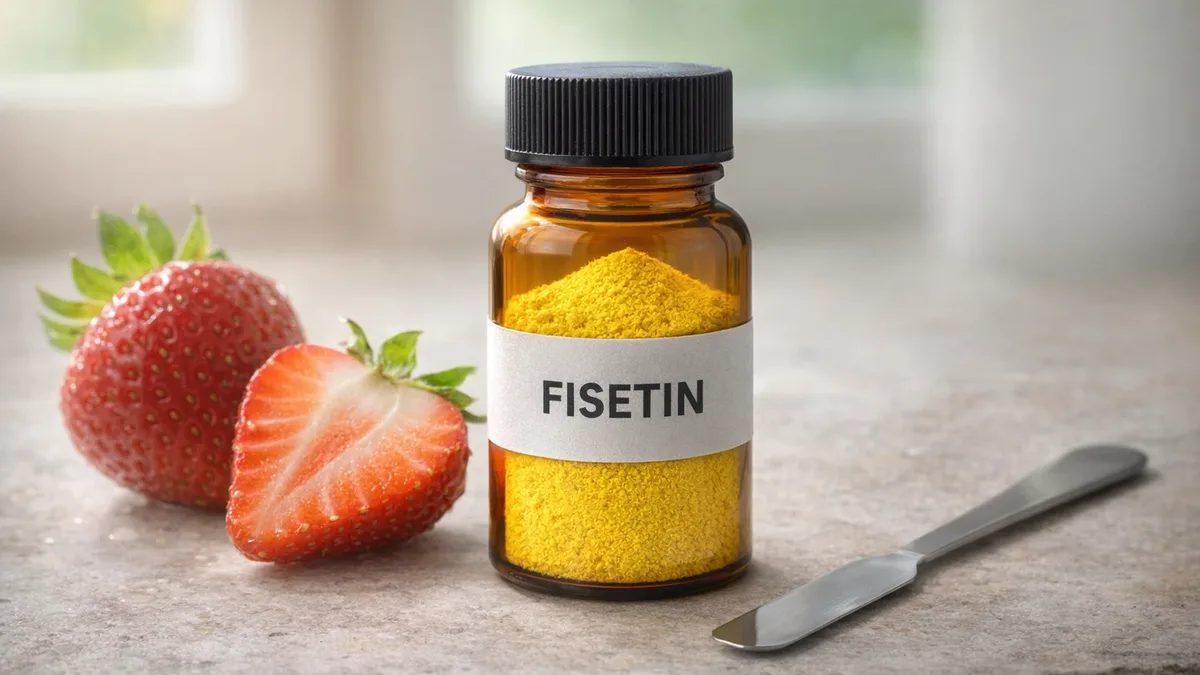
Fisetin is a flavonoid found in several fruits and vegetables and studied as a possible senolytic compound. Animal and laboratory findings have driven early human trials, but clinical evidence remains limited and no approved indication establishes fisetin as an anti-aging treatment.
Senolytic compound
Fisetin
Fisetin is a flavonoid found in several fruits and vegetables and studied as a possible senolytic compound. Animal and laboratory findings have driven early human trials, but clinical evidence remains limited and no approved indication establishes fisetin as an anti-aging treatment.
Evidence review
Last reviewed Jul 1, 2026
Next review Jul 29, 2026
Evidence snapshot
Mayo Clinic researchers conducted a clinical trial of fisetin for COVID-19 in skilled nursing facilities, representing one of the first senolytic trials in the clinical setting (Verdoorn et al., J Am Geriatr Soc, 2021; Kirkland and Tchkonia as senior authors).
A 2024 review characterized fisetin as a senotherapeutic agent with evidence for age-related diseases, noting that while preclinical data is strong, clinical translation remains in early stages (Mech Ageing Dev, 2024).
A Phase II randomized placebo-controlled study (TROFFi) of fisetin to improve physical function in breast cancer survivors was registered in 2026, representing ongoing clinical investigation (Ther Adv Med Oncol, 2026).
Fisetin is available as a dietary supplement but is not FDA-approved as a drug for any indication. Senolytic use involves intermittent high-dose administration, which differs from typical supplement use.
Research record
What the evidence record says
- Evidence grade
- Not Graded
- Regulatory status
- Fisetin regulatory status has not been fully reviewed by Peptide Report editorial team. See company profiles and regulatory watch for current status.
Evidence records
Studies, registries, reviews, and regulatory records
Evidence review pending
- Detailed evidence review for Fisetin is pending editorial assessment. Current summary reflects available public records.
Records: Fisetin for COVID-19 in skilled nursing facilities: Senolytic trials in the COVID era, Fisetin as a senotherapeutic agent: Evidence and perspectives for age-related diseases, A phase II randomized placebo-controlled study of fisetin to improve physical function in breast cancer survivors: the TROFFi study rationale and trial design
Evidence timeline
What changed, and when
Peptide Report last reviewed Fisetin on 2026-07-01.
Records: Fisetin for COVID-19 in skilled nursing facilities: Senolytic trials in the COVID era
Direct answers
Frequently asked questions
What is Fisetin?
Fisetin is a senolytic compound tracked by Peptide Report. See the full profile for current editorial assessment.
Open research questions
What is still unknown
- What is the complete human evidence base for Fisetin?
- What are the long-term safety considerations for Fisetin?
Tracked claims
Fisetin is a senolytic compound that selectively eliminates senescent cells.
Evidence level: Preclinical
Sources: Fisetin for COVID-19 in skilled nursing facilities: Senolytic trials in the COVID era, Fisetin as a senotherapeutic agent: Evidence and perspectives for age-related diseases
How to read this: Senolytic effects are well-established in preclinical models. Human senolytic efficacy data is emerging but not yet conclusive. Cite the Mayo Clinic research directly.
Mayo Clinic researchers have conducted clinical trials of fisetin as a senolytic.
Evidence level: Peer reviewed
Sources: Fisetin for COVID-19 in skilled nursing facilities: Senolytic trials in the COVID era, A phase II randomized placebo-controlled study of fisetin to improve physical function in breast cancer survivors: the TROFFi study rationale and trial design
How to read this: The COVID-19 nursing home trial and the TROFFi breast cancer trial are key clinical studies. Both come from the Kirkland/Tchkonia lab at Mayo Clinic's Kogod Center on Aging. Results are preliminary.
Fisetin is promoted as a 'zombie cell killer' in longevity communities.
Evidence level: Community discussion
Sources: Fisetin as a senotherapeutic agent: Evidence and perspectives for age-related diseases, Fisetin for COVID-19 in skilled nursing facilities: Senolytic trials in the COVID era
How to read this: Track this framing without endorsing it. The 'zombie cell' terminology is a simplification of senescent cell biology. Senolytic dosing in humans is still being investigated in clinical trials.
Free report
Get the source-quality checklist
Use the same checklist Peptide Report uses to separate Fisetin claims, source records, supplier documentation, and media signals.
V1 collects email, role, and topic interest only. No medication, health-condition, dosing, or current-use data is collected in this form.
Formspree processes this submission for Peptide Report. Privacy notice.
Sources on this page
Each source record is linked to the claim or evidence note it supports.
Fisetin for COVID-19 in skilled nursing facilities: Senolytic trials in the COVID era
Fisetin for COVID-19 in skilled nursing facilities: Senolytic trials in the COVID era
2 linked pagesOpen original ·
pubmed-fisetin-senolytic-covid-2021Fisetin as a senotherapeutic agent: Evidence and perspectives for age-related diseases
Fisetin as a senotherapeutic agent: Evidence and perspectives for age-related diseases
2 linked pagesOpen original ·
pubmed-fisetin-senotherapeutic-review-2024A phase II randomized placebo-controlled study of fisetin to improve physical function in breast cancer survivors: the TROFFi study rationale and trial design
A phase II randomized placebo-controlled study of fisetin to improve physical function in breast cancer survivors: the TROFFi study rationale and trial design
1 linked pageOpen original ·
pubmed-fisetin-troffi-2026Related compounds
5-Amino-1MQ
5-Amino-1MQ is a small-molecule NNMT inhibitor with published efficacy findings limited to cell and rodent studies. No e...
Regulatory watchAOD-9604
AOD-9604 is a synthetic fragment of human growth hormone developed as a weight-loss candidate. Its Phase 2 obesity progr...
Regulatory watchArgireline (acetyl hexapeptide-8)
Small studies have reported modest wrinkle changes with some Argireline formulations, but results are inconsistent and o...
Evidence reviewBPC-157
BPC-157 is an experimental peptide with extensive animal research but very limited human evidence. A Phase 1 registry re...
Regulatory watchStay informed