The reviewed human record is narrow and route-specific. Thirteen participants completed a randomized study of a topical post-laser skin-care regimen; it found no objective advantage, although satisfaction was higher. A registered Phase 2 study is testing a topical gel in standardized skin wounds but has no posted result. Broader repair, longevity, hair, and systemic claims draw mainly from mechanistic, animal, or review literature.
Copper peptide
GHK-Cu
GHK-Cu is a copper-binding tripeptide studied mainly in topical skin contexts. In the reviewed sources, one small randomized human study found no objective advantage after laser resurfacing, a Phase 2 topical-wound trial is still recruiting, and comparable human evidence for injectable or systemic claims was not identified.
Evidence review
Last reviewed Jul 16, 2026
Next review Aug 13, 2026
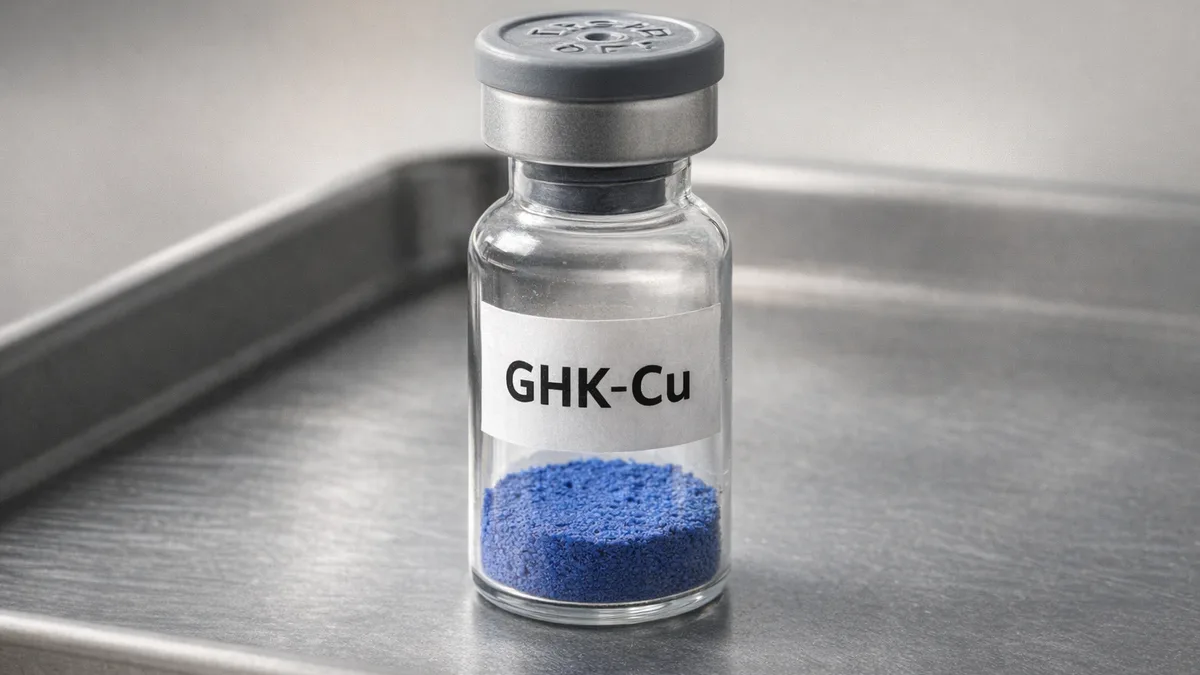
Evidence snapshot
Thirteen participants completed a randomized study after CO2 laser resurfacing. It found no objective advantage for erythema, wrinkles, or overall skin quality, although satisfaction was higher in the GHK-Cu group.
A Phase 2 study of topical GHK-Cu gel is recruiting. The registry has no posted result and cannot support an efficacy claim.
FDA's withdrawn-nomination table includes GHK-Cu for injectable routes and says human safety data are limited.
Context map
Three evidence layers that answer different questions
A study formulation, an online catalog record, and an anecdotal claim are not interchangeable. Each layer below has its own source type and limit.
-
Studied context
Small topical study and an ongoing topical trial
The human records use topical skin products or gel in controlled skin settings.
- Thirteen participants completed the randomized study after CO2 laser resurfacing.
- The ongoing Phase 2 registry uses a controlled split-wound design and has no posted result.
Study records: Topical copper tripeptide complex after laser skin resurfacing, Topical GHK-Cu gel for acute skin wound healing
Evidence boundary: These records do not test the vial and blend formats observed in the research-material market, and they do not establish injectable or systemic effects.
-
Observed market presentation
Research-material vials and blends are cataloged
The market tracker contains observed GHK-Cu product listings and public documentation from research-use-only suppliers.
- The linked product records use vial or blend-vial formats.
- Testing records document fields such as identity, purity, net content, or endotoxin when those fields appear.
- A testing record reports what the linked source contains. It is not a clinical outcome or endorsement.
- Product listings
- 7
- Testing records
- 7
- Observed formats
- Single-compound vials, Combination vials
- Lab-issued, supplier-hosted3
- Supplier summaries2
- Supplier reproduction1
- Supplier-issued document1
Inspect the linked testing records
Evidence boundary: Catalog presence and document coverage do not show that a product matches a studied topical formulation or is safe or effective in people.
-
Anecdotal and media signal
Hair, longevity, and injectable claims drive attention
The video review tracks these themes because readers encounter them, not because the claims are established.
- The hair-growth discussion in the reviewed video still needs direct supporting research.
- Longevity and brain-health discussion is characterized as unconfirmed in humans.
- Injectable anti-aging discussion is separated from the topical human record.
3 claims tracked across 1 video review
Dermatologist video claim auditEvidence boundary: Community stories and creator claims are discovery signals. They cannot establish benefit, incidence, safety, or a treatment protocol.
Research record
What the evidence record says
- Evidence grade
- Limited human evidence
- Regulatory status
- GHK-Cu appears for injectable routes in FDA's table of bulk substances previously in Category 2 whose nominations were withdrawn. FDA cites limited human safety data plus potential immunogenicity from aggregation and peptide-related impurities. GHK-Cu is not in the page's active Category 2 table, and the reviewed records do not establish an FDA-approved injectable indication.
- Also known as
- glycyl-L-histidyl-L-lysine copper complex, copper tripeptide-1
Evidence records
Studies, registries, reviews, and regulatory records
Randomized post-laser study, 2006
- Thirteen participants completed a randomized comparison of post-laser skin-care regimens with or without GHK-Cu.
- Computer analysis and blinded evaluators found no significant difference in resolution of erythema.
- Objective wrinkle and overall skin-quality assessments did not differ between groups.
- Patient-reported satisfaction with overall skin quality was higher in the GHK-Cu group.
- Limits: very small sample, a specific post-procedure setting, and a topical regimen that does not represent systemic or injectable use.
Records: Topical copper tripeptide complex after laser skin resurfacing
Recruiting topical-wound study
- The registry describes a Phase 2 randomized, blinded, vehicle-controlled split-wound study with an estimated 60 healthy adults.
- The study tests a topical gel in standardized acute skin wounds.
- The record was recruiting at its February 2026 verification date and lists no posted results.
- A registered design can show what investigators plan to measure, but it cannot establish efficacy or safety.
Mechanistic and review literature
- The 2015 review covers cellular pathways, animal wound models, skin penetration, and cosmetic reports.
- Mechanistic activity and animal repair findings do not establish a clinical anti-aging, hair-growth, neurologic, or systemic effect.
- The authors were affiliated with Skin Biology Research and Development.
- The review is useful for mapping hypotheses and older studies, but it is not an independent efficacy trial.
Records: GHK peptide as a natural modulator of multiple cellular pathways in skin regeneration
FDA withdrawn-nomination record
- GHK-Cu appears for injectable routes in FDA's table of substances previously in Category 2 whose nominations were withdrawn.
- GHK-Cu is not in the page's active Category 2 table.
- The agency cites potential immunogenicity from aggregation and peptide-related impurities.
- FDA states that human data are limited for safety-related considerations.
- This is a route-specific regulatory concern. It should not be generalized into a claim that every topical cosmetic product has the same risk profile.
Records: FDA BPC-157 compounding safety risk: immunogenicity
Evidence timeline
What changed, and when
A small randomized study of topical copper tripeptide products after CO2 laser resurfacing reported no objective advantage but higher patient satisfaction.
Records: Topical copper tripeptide complex after laser skin resurfacing
An author-linked review summarized cellular, animal, cosmetic, and regenerative research on GHK and GHK-Cu.
Records: GHK peptide as a natural modulator of multiple cellular pathways in skin regeneration
ClinicalTrials.gov posted a recruiting Phase 2 study of topical GHK-Cu gel in standardized acute skin wounds.
FDA's current compounding-risk page included injectable GHK-Cu in its withdrawn-nomination table and described limited human safety data.
Records: FDA BPC-157 compounding safety risk: immunogenicity
Direct answers
Frequently asked questions
What completed human study is available for GHK-Cu?
The completed record reviewed here is a small post-laser study of a topical skin-care regimen. A separate Phase 2 topical wound-gel trial is recruiting, but it has no posted results. Neither record tests injectable or systemic use.
Records: Topical copper tripeptide complex after laser skin resurfacing, Topical GHK-Cu gel for acute skin wound healing
Did the 2006 study show faster healing or better skin?
No objective advantage was found for erythema, wrinkles, or overall skin quality. Patient satisfaction was higher in the GHK-Cu group.
Records: Topical copper tripeptide complex after laser skin resurfacing
Does the recruiting Phase 2 study prove GHK-Cu works?
No. A registry describes a planned study. Until results are posted and reviewed, it provides no efficacy finding.
Do vial testing reports prove a clinical benefit?
No. A testing record can document fields such as identity, purity, or net content. It does not show that a market product matches a studied formulation or produces a health outcome.
Records: stemcode-peptides: public report PDF, Valar Peptides: public report PDF
Is injectable GHK-Cu supported by comparable human evidence?
No comparable human efficacy record was identified in the reviewed sources. FDA also states that human safety data for injectable GHK-Cu are limited.
Records: FDA BPC-157 compounding safety risk: immunogenicity
Is copper tripeptide-1 another name for GHK-Cu?
Copper tripeptide-1 is a name used for the GHK copper complex in cosmetic and registry contexts.
Records: Topical GHK-Cu gel for acute skin wound healing, GHK peptide as a natural modulator of multiple cellular pathways in skin regeneration
Open research questions
What is still unknown
- Whether independent, adequately powered trials reproduce a meaningful topical benefit.
- The eventual results and publication quality of the recruiting Phase 2 wound study.
- How formulation, stability, skin penetration, and local exposure change topical outcomes.
- Human pharmacokinetics, immunogenicity, and short- and long-term safety for injectable use.
- Whether any systemic, hair, neurologic, or longevity claim produces a reproducible human outcome.
- How accurately online product and testing records represent the material actually supplied.
Tracked claims
The completed randomized human study did not show an objective advantage on the measured erythema and appearance outcomes.
Evidence level: Limited human evidence
Sources: Topical copper tripeptide complex after laser skin resurfacing
How to read this: Thirteen participants completed the study. Objective erythema, wrinkle, and overall skin-quality measures did not differ between groups; patient satisfaction was higher with the GHK-Cu regimen.
The registered Phase 2 topical-wound study is a research plan, not a clinical result.
Evidence level: Trial registry
Sources: Topical GHK-Cu gel for acute skin wound healing
How to read this: The registry describes a randomized, blinded, vehicle-controlled split-wound study in healthy adults. It was recruiting at the reviewed cutoff and had no posted outcome data.
Broader regenerative claims rely heavily on cellular, animal, and author-linked review literature.
Evidence level: Mixed evidence
Sources: GHK peptide as a natural modulator of multiple cellular pathways in skin regeneration
How to read this: The review summarizes a wide mechanistic and preclinical literature. Its authors were affiliated with Skin Biology Research and Development, so it should not be treated as independent proof of clinical benefit.
FDA's withdrawn-nomination table says human safety data for injectable GHK-Cu are limited.
Evidence level: Primary regulatory
Sources: FDA BPC-157 compounding safety risk: immunogenicity
How to read this: GHK-Cu is not in FDA's active Category 2 table. It appears in the separate table for substances previously in Category 2 whose nominations were withdrawn. FDA identifies potential immunogenicity concerns from aggregation and peptide-related impurities for compounded injectable GHK-Cu. This route-specific record does not describe a proven benefit.
Free report
Get the source-quality checklist
Use the same checklist Peptide Report uses to separate GHK-Cu claims, source records, supplier documentation, and media signals.
V1 collects email, role, and topic interest only. No medication, health-condition, dosing, or current-use data is collected in this form.
Formspree processes this submission for Peptide Report. Privacy notice.
Sources on this page
Each source record is linked to the claim or evidence note it supports.
Topical copper tripeptide complex after laser skin resurfacing
Randomized topical study with 13 completers after CO2 laser resurfacing. Objective erythema, wrinkle, and overall skin-quality outcomes did not differ between groups, while patient satisfaction was higher with the GHK-Cu regimen.
5 linked pagesOpen original ·
pubmed-ghkcu-postlaser-2006Topical GHK-Cu gel for acute skin wound healing
Recruiting Phase 2 registry record for a randomized, blinded, vehicle-controlled split-wound study of topical GHK-Cu gel in an estimated 60 healthy adults. No results are posted.
2 linked pagesOpen original ·
clinicaltrials-ghkcu-wound-2026GHK peptide as a natural modulator of multiple cellular pathways in skin regeneration
Author-linked review of cellular, animal, skin-penetration, and cosmetic research involving GHK and GHK-Cu. The authors were affiliated with Skin Biology Research and Development, so the review is useful for mapping hypotheses but is not independent clinical efficacy evidence.
4 linked pagesOpen original ·
pubmed-ghk-skin-regeneration-review-2015Certain bulk drug substances for use in compounding may present significant safety risks
FDA risk page lists BPC-157: compounded BPC-157 may pose immunogenicity risk and peptide-related impurity concerns for certain routes of administration.
41 linked pagesOpen original ·
fda-bulk-risk-liststemcode-peptides: public report PDF
Supplier-published PDF from stemcode-peptides reviewed as a sample documentation record. It applies only to the listed sample, batch, methods, and date.
3 linked pagesOpen original ·
external-stemcode-peptides-public-report-pdf-986a2aValar Peptides: public report PDF
Supplier-published PDF from Valar Peptides reviewed as a sample documentation record. It applies only to the listed sample, batch, methods, and date.
2 linked pagesOpen original ·
external-valar-peptides-public-report-pdf-3baefaRelated compounds
5-Amino-1MQ
5-Amino-1MQ is a small-molecule NNMT inhibitor with published efficacy findings limited to cell and rodent studies. No e...
Regulatory watchAOD-9604
AOD-9604 is a synthetic fragment of human growth hormone developed as a weight-loss candidate. Its Phase 2 obesity progr...
Regulatory watchArgireline (acetyl hexapeptide-8)
Small studies have reported modest wrinkle changes with some Argireline formulations, but results are inconsistent and o...
Evidence reviewBPC-157
BPC-157 is an experimental peptide with extensive animal research but very limited human evidence. A Phase 1 registry re...
Regulatory watch